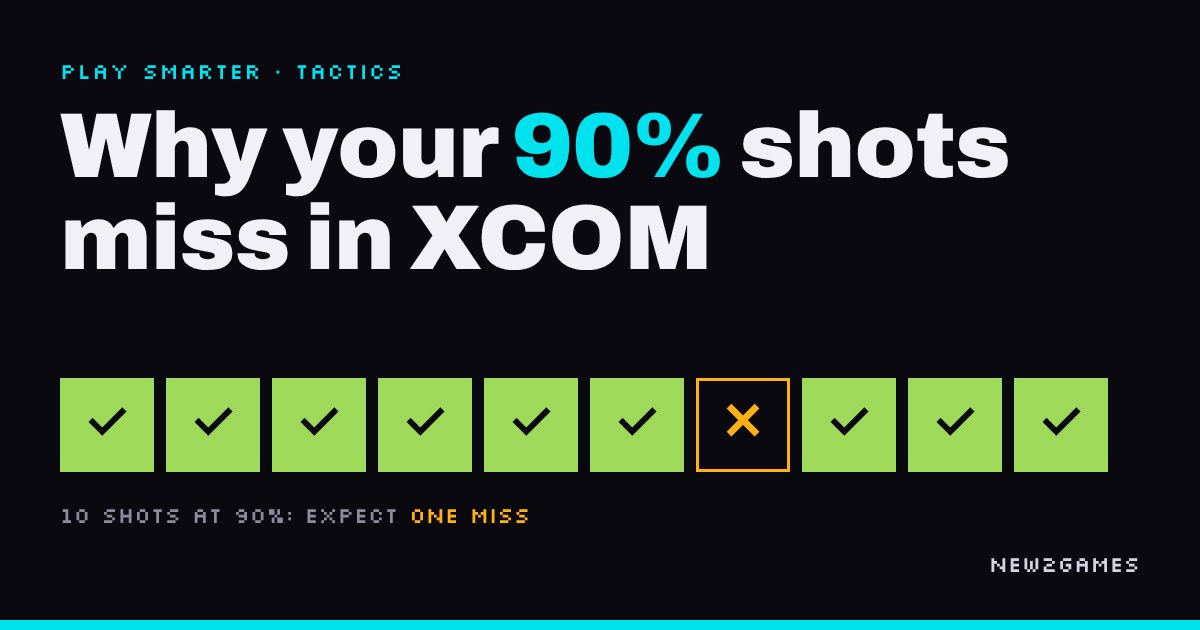
A 90% shot misses one time in ten, and an XCOM 2 mission asks for dozens of shots, so misses are certain. Plan turns so one miss doesn't cost a soldier.
A plain guide to playing the odds in turn-based tactics: what the hit chance means, why misses arrive in runs, and four habits that make them survivable (shot order, a plan B, flanking to change the odds, judging decisions rather than results). With a turn planner that shows how much a second shooter changes, and what to play if you'd rather have no dice at all.
Your 90% shots miss because 90% means one miss in every ten, and a mission in XCOM 2 asks for dozens of shots. The game isn't cheating you; if anything, on its easier settings it quietly leans your way. The fix isn't hoping for better rolls. It's planning turns so that a miss doesn't cost you a soldier: shoot in the right order, keep a fallback, and turn shots into sure things before you take them.
If you've ever watched a rookie whiff a point-blank shot and then lose that rookie on the alien turn, this guide is for you. Nothing here needs maths beyond one idea: chances multiply.
What the percentage actually means
In XCOM 2 (Firaxis, PC in February 2016, PlayStation 4 and Xbox One in September 2016), every shot shows a hit chance before you take it. Your soldier's aim, the distance and the target's defense (how hard it is to hit) go into that number. Cover is the big one: low cover adds 20 defense, high cover adds 40, and an enemy that hunkers down adds another 30 on top.
Then the game rolls. A 90% shot misses one time in ten, on average, and nothing stops two of those misses arriving back to back. Over a mission with thirty shots at 90%, you should expect about three misses. They will feel like bad luck. They're the number on the screen doing its job.
Two things make misses feel worse than they are. First, you remember the miss that got someone killed and forget the twenty hits that didn't matter. Second, a single shot is all-or-nothing, so a high chance still leaves a real hole. The way out is to stop asking one shot to carry the turn.
Try it: how likely is this turn to work?
Pick the hit chance, how many soldiers can shoot this enemy, and how many hits it takes to kill. The planner shows the chance the enemy is dead by the end of your turn, then lets you play the same turn twenty times to see how the misses cluster.
Two lessons fall out quickly. A second shooter turns a shaky 65% shot into a kill nearly nine times in ten. And an enemy that needs two hits is far harder to remove than the single hit chance suggests: two soldiers at 65% both connect less than half the time. Press the roll button a few times and you'll also see failures arrive in runs, which is exactly what fair dice do.
Four habits that make misses survivable
1. Shoot in an order that keeps options open
Take the shot whose result changes your plan first. If your sniper's shot decides whether your ranger needs to run in with a sword, the sniper goes first. Save soldiers with flexible actions (moving, healing, a grenade) for last, so they can clean up whatever the dice left behind.
2. Always know your plan B before plan A
Before each shot, ask: "If this misses, what does the next soldier do?" If the honest answer is "nothing, and the enemy kills someone", don't start with that shot. Put a soldier into overwatch (a reaction shot on the enemy's turn), pull a wounded soldier back, or hunker down first.
3. Change the odds instead of taking them
Many bad shots can be made good ones. Flanking means moving to where the enemy's cover doesn't protect it: an enemy you've flanked gets no defense from that cover, and your chance of a critical hit (extra damage) goes up. A frag grenade destroys the cover an enemy is using, so the shot after it gets easier. A turn spent moving into a flank often beats a turn spent rolling a 45% shot.
4. Measure decisions, not results
A 90% shot that misses was still the right call if the alternatives were worse. Judge your turn by the odds you chose, not by how the dice landed. That's how poker players learn, and it's how you stop a bad mission from teaching you the wrong lesson.
Is the game rigged?
Not against you. Community digging through XCOM 2's configuration files (summarised on the fan wiki UFOpaedia) found hidden aim help that is significant on Rookie, smaller on Veteran and Commander, and absent on Legend. So on the easier settings, your real odds are, if anything, a little better than the screen says. On Legend, the number is the number.
The difficulty you're feeling has two main sources. One is Consequence: soldiers who die stay dead, and in Ironman mode (a single save you can't reload) every roll is final. The other is Systems: cover, flanks, defense and timing interact, and good turns come from reading them. Dice don't make the game random; they make it a game about managing risk.
If dice are what you hate
That's a fair dislike, and the genre has an answer. Into the Breach (Subset Games, PC in February 2018, Switch later that year) is a tactics game that shows you exactly what every enemy will attack on its next turn. Its difficulty is almost all Systems: a puzzle of positions and pushes, with little left to luck (the main visible dice is a "grid defense" chance that a building shrugs off damage). Playing it trains the same habit XCOM rewards: work out what goes wrong before you commit.
If you want to learn the dice instead, XCOM 2 on Rookie or Veteran is a forgiving place to practise the four habits above. Start a mission, and before every shot, say your plan B out loud.
Affiliate links, marked sponsored. We may earn a commission at no extra cost to you. Examples that match this guide, not tested reviews. Prices checked 21 Nov; every shop and live prices are on each product page.