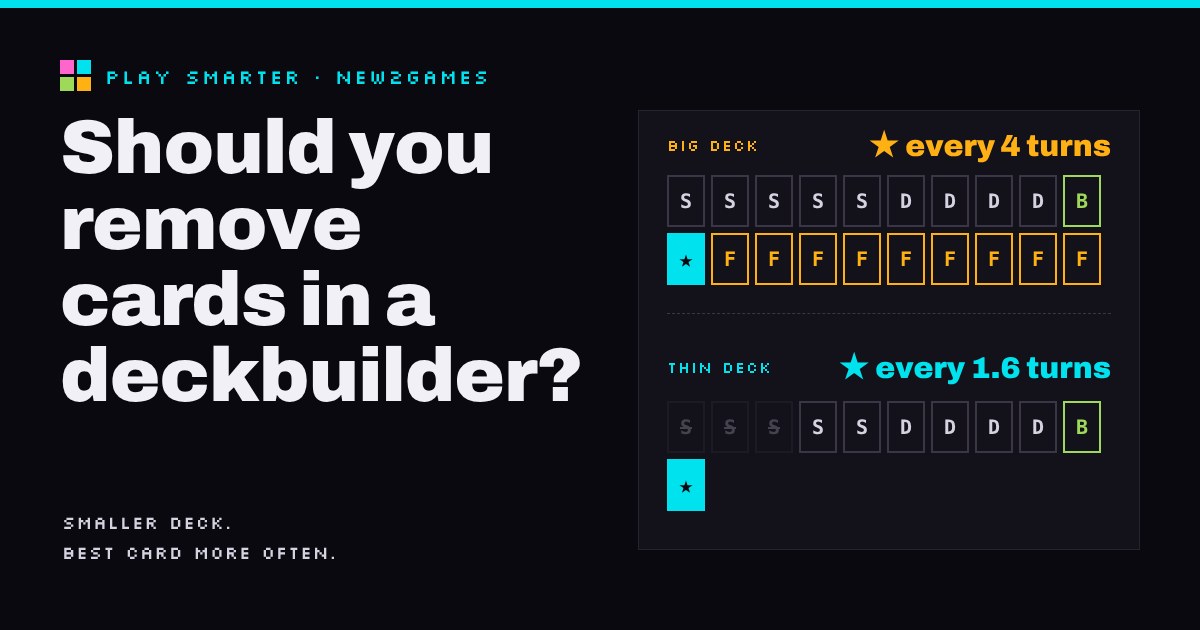
Usually yes: removing weak starting cards makes your best cards show up more often, because a smaller deck cycles faster. Skipping so-so card rewards does the same.
This guide uses Slay the Spire to show the arithmetic behind deck thinning: you draw five cards a turn and reshuffle when the pile runs out, so a 10-card deck shows every card every two turns and a 20-card deck every four. A small deck simulator lets you cut Strikes or add filler and watch how often your star card turns up. It also covers what to cut first, what removal costs, and when a thin deck backfires.
▶ Interactive · Should you remove cards in a deckbuilder?
Usually yes, especially early: removing weak starting cards from a deckbuilder deck makes your best cards show up more often, because you draw from a smaller pile. In Slay the Spire you draw five cards a turn, so in a ten-card deck you see every card every two turns. Add ten cards and that becomes four turns. Removal isn't free and it isn't always right, but understanding this one bit of arithmetic will change how you take card rewards and spend gold.
This guide uses Slay the Spire, one of the best-known roguelike deckbuilders, as the example. (New to the "roguelike" half of that? Start with what a roguelike is.) The same maths applies to tabletop deckbuilders like Dominion, where removing a card is called trashing.
The shuffle is the whole trick
In a deckbuilder your deck is not a hand of cards you choose from. It is a pile you cycle through. In Slay the Spire, each fight starts with your whole deck shuffled into a draw pile. You draw five, play what you can with your three energy, and the rest of your hand goes to the discard pile at the end of the turn. When the draw pile runs out, the discard pile is shuffled back in and the cycle repeats.
That means every card gets drawn exactly once per pass through the deck, unless something like extra card draw changes it. Over a long fight, the number of times you see any single card works out to about 5 divided by your deck size, per turn:
Deck size
Your best card
8 cards
about every 1.6 turns
10 cards
every 2 turns
20 cards
every 4 turns
30 cards
every 6 turns
The Ironclad, the first character you play, starts with 10 cards: five Strikes, four Defends and one Bash. Strikes and Defends are deliberately plain. Every good card you pick up has to compete with them for a place in your hand, and every Strike you remove is one less weak card standing between you and the good ones.
Start with the starting deck plus one star card and press "Draw a turn" a few times: the star turns up roughly every other turn. Now remove three Strikes and draw again; it shows up most turns. Then reset and add five filler cards instead. Nothing in the deck got worse, but your best card now sits out for three turns at a time, and the "starters per hand" number barely moves, because the filler took the space instead.
Skipping a card is a form of removal
The quieter lesson is about taking cards, not cutting them. After most fights Slay the Spire offers you a card, and you can skip it. A card that is only a bit better than a Strike still makes your deck bigger, which pushes your best cards further apart. Before you take one, ask: would I be happy to draw this instead of my best card? If not, skipping is often the stronger play, even though it feels like turning down a free gift.
Card removal itself costs something. The merchant offers a removal service for gold that could have bought a relic or a card. The Peace Pipe relic adds a rest-site option to remove a card, which means not resting or upgrading that time. Some cards can't be removed at all, such as the Ascender's Bane curse added at higher difficulty levels. Treat a removal like any other purchase: good value early, when your deck is mostly starters, and less urgent once your deck is full of cards you actually want.
What to cut first
Our rule of thumb, and the reasoning behind it:
Curses first. Curse cards do nothing useful and many have a downside, so they are pure clutter.
Then Strikes, usually. Most attacks you pick up do more damage than a Strike, so Strikes are the first cards to become redundant.
Defends later. Blocking damage stays useful for the whole run, and good defensive cards tend to arrive later than good attacks.
This is an argument, not a law. Some characters and builds lean on cards that care about specific card types, and a Defend can be the right thing to keep if your deck has few ways to block. Look at what your deck is short of before cutting.
When a thin deck backfires
The strongest case against cutting hard is that some enemies add junk to your deck for the fight. The Sentry, for example, adds Dazed cards to your discard pile, and Dazed can't be played. In a 25-card deck two Dazed are a small nuisance. In an 8-card deck they are a fifth of everything you draw. A very lean deck is fast, but it is also fragile.
Thin decks also leave less room for bad luck in other ways. If your few remaining cards are all attacks, a fight that demands blocking can go badly, and there are fewer cards in the pile to bail you out. The goal is not the smallest deck possible. It is a deck where almost every draw is a card you are glad to see.
Same idea, different table
In Dominion, the 2008 card game by Donald X. Vaccarino, everyone starts with seven Coppers and three Estates, draws five, and reshuffles their discard pile when the deck runs out. Estates are worth points at the end but do nothing while you hold them, so they clog your hand exactly like Strikes. Cards that trash other cards are how experienced players thin out that starting clutter, and the same tension applies: every turn spent trashing is a turn not spent buying.
Who this is for
This is for you if you are a few runs into Slay the Spire or a similar game and your decks feel strong on paper but inconsistent in fights. If you are still learning what the cards do, don't worry about removal yet: play a few runs taking whatever looks fun, then come back to this.
Quick answers
Should I always remove cards when I can?
No: it is usually worth it early when your deck is full of starters, but weigh it against what the gold or rest could buy.
Is it bad to skip card rewards?
No, skipping a mediocre card keeps your best cards coming round more often.
Strike or Defend: which goes first?
Usually Strike, because new attacks replace it sooner, but keep Defends if your deck is short on block.
Next step: on your next run, skip at least two card rewards in the first act and spend your first merchant visit on a removal. Then watch how often your best card turns up compared with last time. For more on how game randomness plays out over many draws, see also new2gaming's explainer on why a 1% drop chance isn't 1 in 100.
Loadout · gear used
Affiliate links, marked sponsored. We may earn a commission at no extra cost to you. Examples that match this guide, not tested reviews. Prices checked 28 Oct; every shop and live prices are on each product page.