What is a roguelike? A first-timer's guide
A roguelike is a game built around runs: random levels, and when you die you start again from the beginning. A roguelite lets you keep upgrades between runs.
This guide explains where the name comes from, what permadeath and meta-progression mean, and why the genre feels hard: failure is costly, and each kind adds its own challenge, from reflexes to card maths. A playable tower shows what changes when death lets you keep something, and we make the case for which game to start with, depending on what you already enjoy.
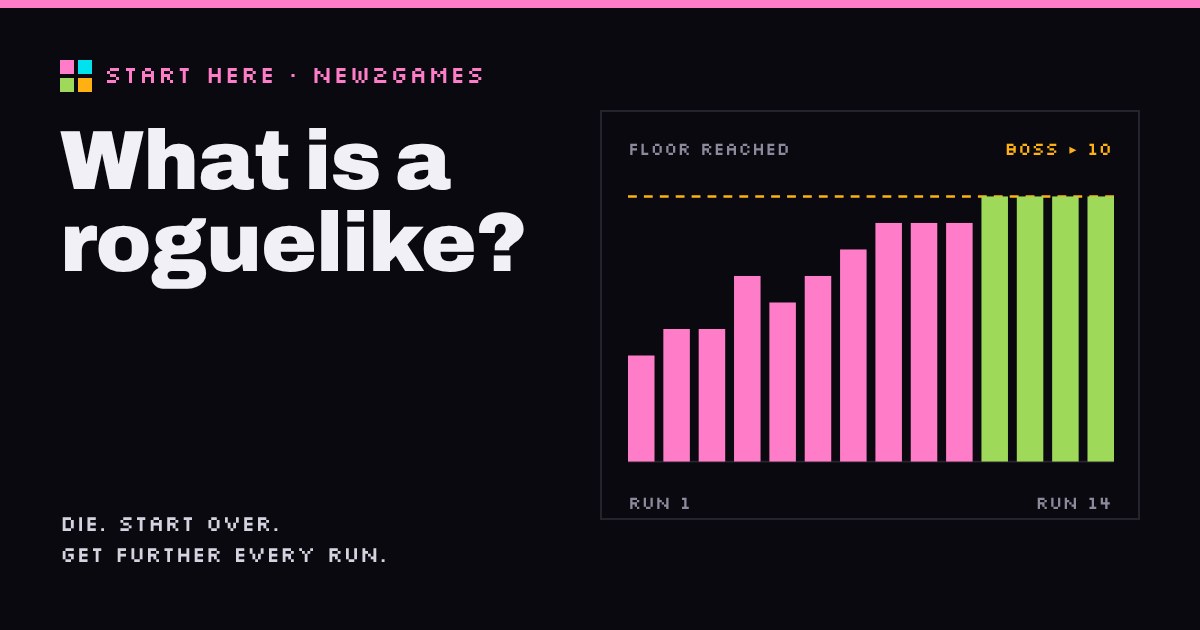
A roguelike is a game built around runs: you start fresh, push through randomly generated levels, and when you die, the run is over and you start again from the beginning. A roguelite is the friendlier cousin: death still ends the run, but you keep something, usually a currency you spend on permanent upgrades. In both, the most important thing you carry from one run to the next is what you learned.
Dying over and over feels like failing until you notice you are getting further each time. The game was designed for exactly that.
Where the name comes from
The genre is named after Rogue, a 1980 dungeon crawler made by Michael Toy and Glenn Wichman (with later work by Ken Arnold) for Unix computers. It was drawn in text characters on a grid, it was turn-based, and every dungeon was generated randomly, so no two games were the same. Death was final: the game deleted your save so you couldn't reload and try again. Wichman's name for that idea was "consequence persistence".
Three ideas from Rogue still define the genre today:
- Runs. One attempt, start to finish (or start to death). A run is the unit of play, the way a match is in a sports game.
- Permadeath. Short for permanent death: when you die, that run and everything you picked up in it is gone. No checkpoint, no reload.
- Procedural generation. The levels, enemies and loot are assembled by the game from rules and randomness each time, rather than designed once by hand. So you can't memorise a route; you have to learn how the game works.
Roguelike or roguelite?
In 2008, people at the first International Roguelike Development Conference in Berlin wrote down a list of traits that make a game more or less "roguelike". It is known as the Berlin Interpretation, and it sticks close to Rogue: turn-based, grid-based, permadeath, random dungeons.
So a second word appeared. A roguelite keeps runs, permadeath and randomness, but adds meta-progression: things that survive death and make later runs easier. In Hades you lose your boons and coins when you die, but the currency you spend at the House of Hades buys upgrades that stay. In Dead Cells, the cells you collect buy permanent unlocks, but only if you reach a spending point before dying.
Neither label is a grade, and plenty of players use "roguelike" for both. The useful question for a newcomer is simpler: when I die, what do I keep? The toy below shows why that matters.
Play twenty runs in each mode and two things show up. First, the bars climb in both modes, because the player in the model gets a little better every run: that's knowledge, and nothing can take it away. Second, the roguelite climbs faster, because it adds kept upgrades on top. That is the whole trade. A strict roguelike asks you to make all the progress yourself: harsher, and for some players more satisfying.
What makes them hard
We don't give games a single difficulty number on this site, because "hard" means different things. We describe difficulty by its sources. For roguelikes, one source is always loud: Consequence, what failure costs you. Losing a forty-minute run hurts in a way that losing a checkpoint doesn't. Meta-progression is, in effect, a dial on that cost.
The second source depends on which kind of roguelike you pick, and this is where the genre splits into games that should not be compared with each other:
| Kind | Examples | Loudest sources (our scoring) |
|---|---|---|
| Traditional, turn-based | Rogue and its descendants | Consequence, Systems |
| Action roguelite | Hades, Dead Cells | Execution, softened Consequence |
| Platformer roguelike | Spelunky | Execution, Consequence |
| Roguelike deckbuilder | Slay the Spire, Balatro | Systems, Consequence |
Execution means reflexes, timing and precision. Systems means understanding how rules interact, like which cards combine well. An action roguelite and a deckbuilder share a run structure but can feel like different genres.
The real upgrade is you
The skills a roguelike teaches carry over to every other roguelike, which is why your second one is so much easier than your first:
- Reading a run early. Noticing in the first few minutes what this run is good at, and leaning into it.
- Playing the hand you're dealt. Adapting to the random items you got instead of forcing the plan you wanted.
- Health as a resource. Treating health as something to spend on a reward, not a bar to keep full at all costs.
- Risk budgeting. Deciding when an optional tough fight is worth it and when to walk past.
- Learning from each death. Asking "what killed me, and what would I do differently?" before you start the next run.
One habit works against you, so think of it as a warning rather than a skill: treating a run as precious. Players coming from story games tend to hoard potions and play every room as safely as possible because losing progress feels terrible. In a roguelike, a run you never risk is usually a run that ends on the same floor as the last one. The genre rewards spending your resources and accepting that some runs are experiments.
Where to start (here's the case)
This is our argument, not a fact: start with the roguelike whose second difficulty source you are already comfortable with, so the only new thing you are learning is the run structure itself.
- If you play action games: Hades. It is a roguelite, so death always buys you something, and the story moves forward every time you die, which turns failure into a reason to keep going. It also has an optional God Mode: you start with 20% damage resistance, and it rises by 2% each time you die, up to 80%.
- If you prefer thinking to reflexes: Slay the Spire. It is turn-based, so there is no execution pressure at all, and enemies show what they intend to do next turn, so every decision is a readable puzzle.
- If you already know poker hands: Balatro. The rules you need on day one are ones you already have, so the first game in your roguelike journey can bridge from something familiar.
The strongest counter-view: some players argue you should start with a stricter game like Spelunky, because a roguelite's upgrades can hide whether you are actually improving, and a strict roguelike makes the lesson "knowledge is the only upgrade" impossible to miss. That's fair, and if you enjoy a sharp challenge it may suit you better. Our view: a newcomer who quits after one evening learns nothing, so a gentler first curve is worth it.
Who this is for, who should skip it
For you if: you like getting visibly better at something, short sessions suit you, and you enjoy surprises. Maybe skip for now if: you want a long story you can see through in one go, or losing progress genuinely ruins your evening. Then start with a roguelite and use any assist option it offers.
See also: how procedural generation builds random levels on new2gaming.
Quick answers
Is a roguelike the same as a roguelite?
Not quite: both end the run when you die, but a roguelite lets you keep upgrades between runs and a strict roguelike doesn't.
Are roguelikes too hard for beginners?
No; they are built to be failed, and most modern roguelites give you permanent upgrades or assist options so every run moves you forward.
Why do roguelikes make you start over?
Because the challenge is learning the game's rules well enough to win a fresh, random run, and keeping your progress would skip that.
Your next step: pick the one game from the list above that matches what you already enjoy, play three runs, and after each death say out loud what killed you. By run three you'll feel the curve start to bend.