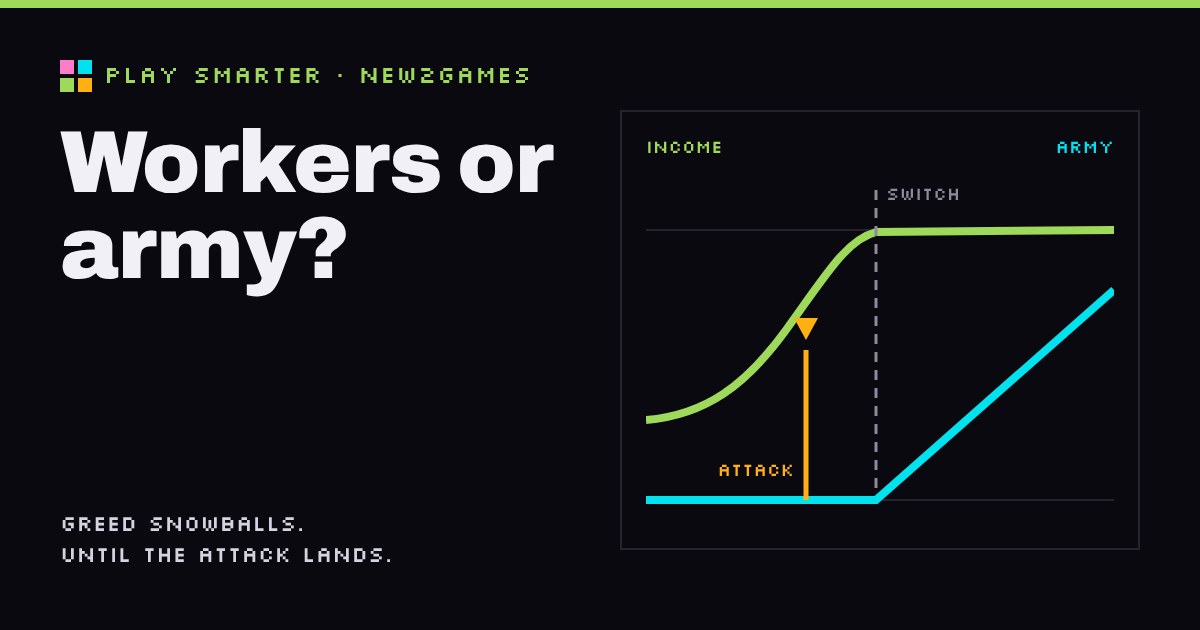
In most RTS games, building workers early wins because income compounds: workers pay for more workers. The risk is an attack that lands before your greed pays off.
This guide explains why worker production snowballs, why it stops paying once a base is saturated, and how rushes and timing attacks punish an economy that hasn't turned into army yet. A sandbox lets you pick when to stop building workers and see your income, your army and an enemy attack play out, so you can feel both the snowball and the risk.
▶ Interactive · Workers or army? How economy wins RTS games
In most real-time strategy (RTS) games, the player with more workers early usually ends up with the bigger army later, because workers pay for more workers and income compounds. The catch is that every worker you build is a soldier you didn't, so a greedy economy is only safe until someone attacks it. Getting good at RTS economy means learning both halves: build workers without stopping, and know the moment to stop.
Why workers snowball
Most classic RTS games split your units into two jobs. Workers (StarCraft's SCVs, Probes and Drones, Age of Empires' villagers) gather resources. Army units fight. Workers don't win fights, but they pay for everything, including more workers.
That loop is why early investment compounds, like interest on savings. A worker built in the first minute gathers for the whole game. Each one raises your income a little, which lets you afford the next one a little sooner, which raises income again. Two players who make the same decisions except that one keeps building workers for an extra minute can end up with very different armies ten minutes later.
Both big franchises push you toward this. In Age of Empires II most civilisations start with a Town Center, a scout and three villagers, and guides repeat one rule above all others: never let the Town Center sit idle. When Blizzard designed StarCraft II: Legacy of the Void, it raised the number of starting workers from six to twelve, saying it wanted to cut down the passive opening minutes. More workers at the start means the snowball starts rolling sooner.
Greed has a ceiling
Workers don't pay off forever. Every resource node can only be worked so fast. In StarCraft II a normal base has 8 mineral patches; the first two workers on a patch each gather at full speed, a third adds only about half as much again, and a fourth adds nothing, according to Liquipedia's mining page. Players call a base with enough workers saturated. Past that point, a new worker costs the same as before and earns almost nothing.
So "build workers" really means "build workers until this base is saturated, then expand to a new base or switch to army". Building past saturation is the beginner version of greed: it looks like investing, but the money is gone and nothing comes back.
Start on "No attack" and drag the slider. The army at 12:00 peaks when you stop at about the moment the base fills up: earlier and you left income on the table, later and you paid for workers with nothing to gather. Then pick "Timing 4:00" and try the same setting. Your base is the richest on the map and it dies with an empty army, because the money was still in workers when the attack arrived.
When greed gets punished
The counter to a greedy economy is an attack that lands before the greed pays off. RTS players have names for the flavours:
Rush: skip most of the economy and attack very early, before the other player has anything to defend with.
Timing attack: build a decent economy, then commit to a strong attack at a planned moment when you are briefly stronger, before the opponent's investment turns into army.
All-in: an attack that spends so much on army, often pulling workers to fight, that if it fails the attacker has little left. Liquipedia's entry on "cheese" describes these builds as trading economy for an early hit that relies on surprise.
Every one of these is a bet. The attacker gave up income to have an army sooner. If you hold, you are ahead: their army is spent and your economy is bigger. Try it in the sandbox: on "Rush 3:00", stop at 2:00 and you end the game with more than twice the army the rusher has. Defending at home usually helps too, because your reinforcements arrive faster and your buildings help; the toy gives the defender a small bonus for that.
So the right amount of greed isn't a fixed number. It depends on what the other player is doing, which is why good players scout: send a worker or a fast unit to look at the opponent's base early. Few workers and lots of military buildings means an attack is coming, so cut workers a little sooner and build defence. A base full of workers and a second base going up means they are greedy too, and matching their greed is safe.
What makes RTS economy hard
We describe difficulty by its sources, not a single score. For this skill, two are loud (our scoring). Systems: knowing your game's numbers, such as when a base is saturated and what an attack at four minutes looks like. Competition: the right answer depends on a real opponent who is trying to read you back. There's a quieter Execution load too, often called macro: remembering to queue the next worker while your attention is on a fight.
One habit is a warning rather than a skill. If you come from city-builders or single-player campaigns, your instinct is to grow without limit, because nobody ever attacks on a clock. Against a human, that instinct gets punished at exactly the moment the sandbox shows: the minute before your economy turns into army.
The skills that carry to every RTS
Constant worker production. The cheapest improvement in the genre. An idle Town Center or Nexus is lost income you never get back.
Knowing the ceiling. Learn your game's saturation point and expand or switch when you reach it.
Scouting. Information decides how greedy you can afford to be.
Reading the clock. Know roughly when the common attacks in your game arrive, so you're ready a little before them.
Converting on time. Turning income into army just before you need it, not after.
Quick answers
Should I always build workers non-stop in an RTS?
In the early game, almost always, until your bases are saturated or you scout an attack coming.
How many workers per base in StarCraft II?
About two per mineral patch for full-speed mining, so 16 on a normal 8-patch base, plus three per gas; a third worker per patch adds less.
What is a timing attack?
An attack aimed at a moment when you are briefly stronger than your opponent, usually before their economic investment has turned into army.
Your next step: in your next RTS match against the AI, make one goal only: never let your worker production stop until your first base is full. Ignore your army size. Then compare how big your army was at the ten-minute mark with your last game.
Loadout · gear used
Affiliate links, marked sponsored. We may earn a commission at no extra cost to you. Examples that match this guide, not tested reviews. Prices checked 25 Oct; every shop and live prices are on each product page.