Most fast fighting-game attacks hit before an average human can react, so good players react only to slow moves and plan ahead for the fast ones.
An average reaction to one clear signal is about 16 frames at 60 fps; a quick low kick can hit in 5. Choices make you slower still. Test your own reaction against real move startups, then learn the four habits that replace reacting: a default guard, watching for one slow move, reading habits, and accepting some lost guesses.
▶ Interactive · Why you can't react to fast fighting game moves
You can't react to most fast attacks in a fighting game because they finish before your brain does: a typical person needs about a quarter of a second to respond to a single expected signal, and many attacks hit in a third of that. Good players aren't reacting faster than you. They react only to the slow, obvious moves and decide in advance what to do about the fast ones. That split is a skill, and you can practise it.
If you have ever watched a replay and thought "I saw that coming", this is why: seeing a move and answering it run at different speeds.
Time in frames
Fighting games measure time in frames, the single pictures the game draws in a row. Street Fighter 6, like most modern fighters, runs at 60 frames per second, so one frame lasts about 16.7 milliseconds (thousandths of a second). An attack's startup is how many frames it takes, from the button press, before it can hit you. Players share these numbers as frame data.
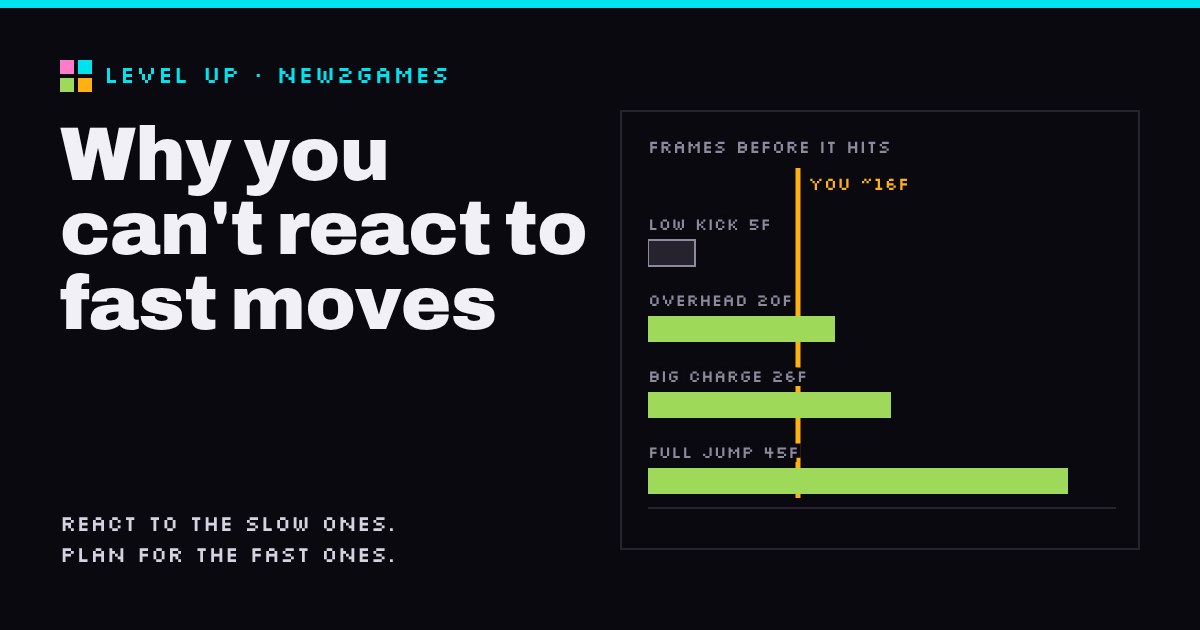
Now put a human next to that clock. The fighting-game writer Infil, using results from a popular online reaction test, puts the average reaction to one clear signal at around 265 ms. That is roughly 16 frames. Here is how some real moves compare:
Move
Startup
Time
Ryu's crouching light kick (SF6)
5f
83 ms
Ryu's overhead punch (SF6)
20f
333 ms
Drive Impact (SF6)
~26f
433 ms
A full jump (Killer Instinct)
~45f
750 ms
A 5-frame low kick is over three times faster than an average reaction, and no amount of focus fixes that. Drive Impact, a slow armoured charge every Street Fighter 6 character has, is the opposite: guides teach you to counter it on sight.
Why the real number is worse
That 16-frame figure is a best case. Infil calls it a theoretical target and warns it isn't that simple in practice, for three reasons.
Choices slow you down. A test with one light and one button measures simple reaction time. A fight gives you choice reaction time: is it high or low, and which answer goes with it? Psychology teaching material puts lab-style simple reactions for many people under 200 ms, but two-choice reactions usually average 350 to 450 ms. More options, slower answers. This is known as Hick's law.
Some answers are slower than others. Switching from crouch-block to stand-block is a tiny movement. Pressing a specific button is slower, and a special move that needs a stick motion plus a button is slower still.
Your screen adds delay. Every display and controller adds a little lag, so you see the move a moment after it starts and the game hears your answer a moment after you give it.
Designers know all this. A mix-up is a situation where the attacker has two or more options that need different defences, often made to look alike for the first few frames. It is aimed squarely at choice reaction time.
Try it yourself. The tester measures your reaction on this device, then lines it up against the moves above. Do ten tries in "One signal" mode, then ten in "Mix-up", where you must pick the right guard.
Expect two things. Your single-signal time will land somewhere near the overhead bar, so slow moves feel catchable and the low kick never does. And your mix-up average will usually be slower, often too slow for the overhead, even though a big lit-up word is far easier to read than a fighter's animation.
What to do instead: react to one thing, guess the rest
Since you can't react to everything, the skill is choosing what to react to and having a plan for the rest. It falls into four habits.
1. Have a default guard. In many fighters, lows are fast and standing overheads are slower (compare Ryu's 5-frame low kick with his 20-frame overhead). So crouch-blocking is the usual default: you are already safe against the fast option and only need to stand up for the slow one.
2. Watch for one slow move at a time. Turning a choice reaction back into a simple one is the biggest speed-up available. Decide "this round, I'm only looking for the Drive Impact" and let your default guard handle everything else. When you can catch it reliably, add the next thing.
3. Read habits, not hands. People repeat themselves under pressure. If someone used the overhead after the last two knockdowns, expect a third. Fighting-game players call this conditioning (teaching an opponent to expect something, then doing something else) and it works in both directions: you can be conditioned too.
4. Accept that some guesses lose. A well-built mix-up is supposed to win sometimes. Getting hit by the option you didn't pick isn't a reaction failure; it's the cost of a guess. What matters is whether you guess better as the match goes on.
One warning, rather than a skill: newcomers often try to react to everything, waiting to see what happens before committing to anything. That instinct feels careful, but it makes you slowest at the moments that matter, because you are always running a many-choice reaction. Pick a plan and let it be wrong sometimes.
In this site's terms, fighting games lean on two difficulty sources: Execution (timing and precision) and, against people, Competition (the difficulty is the other person). These habits shift weight from the first to the second: less raw speed, more reading.
Practise it in training mode
Most modern fighters let you record the training dummy and play the recording back. Record two attacks, one slow overhead and one fast low, and set the dummy to pick between them at random. Crouch-block by default and stand up only for the overhead. Unlike a match, it asks you the same question over and over.
Slow ones, sometimes: a 20-frame overhead sits right at the edge of an average reaction, so it's catchable if it's the only thing you're watching for.
Can reaction time be trained?
Practice mostly helps you recognise specific moves sooner and narrow your choices, which matters more in a match than your raw speed on a test.
Is blocking a fast low on reaction possible?
No: at 5 frames it lands long before anyone can respond, so you block it by already crouching.
Your next step: run the tester until your one-signal average settles, note which bars you beat, then spend ten minutes in your game's training mode reacting only to the slow move and crouch-blocking everything else.
Loadout · gear used
Affiliate links, marked sponsored. We may earn a commission at no extra cost to you. Examples that match this guide, not tested reviews. Prices checked 25 Oct; every shop and live prices are on each product page.