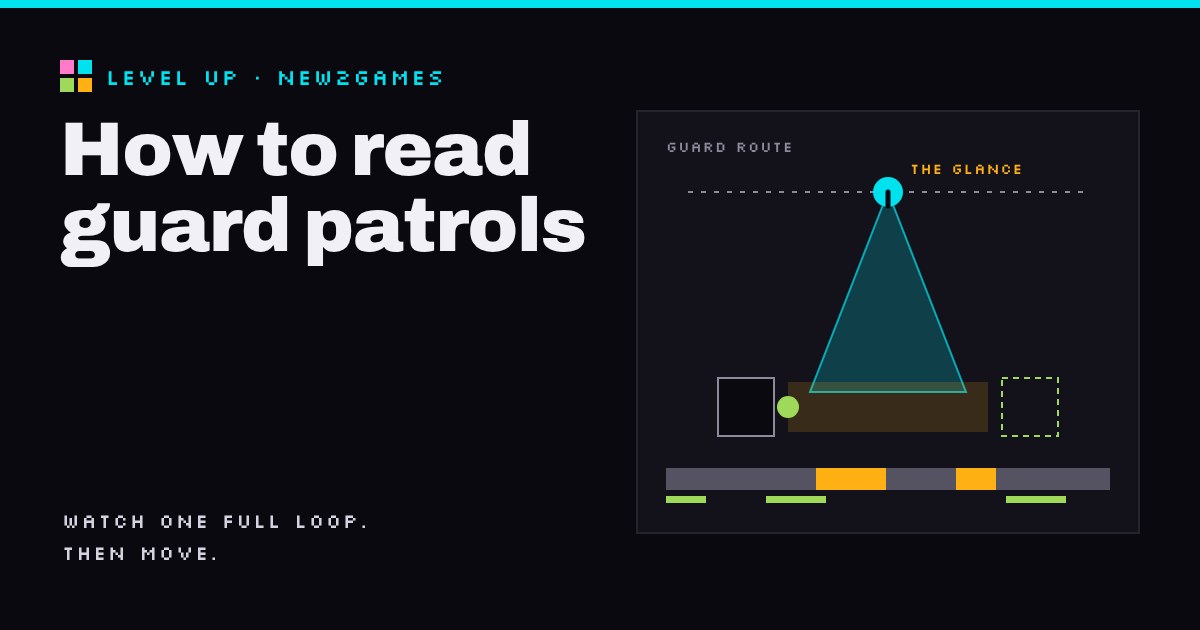
To read a guard patrol, watch one full loop, find when his eyes are off your path, and cross in that window at a speed quiet enough for how close he is.
Most stealth guards walk a loop with a turn at each end, and often a glance in the middle that catches anyone who moved too soon. Try a patrol toy that reveals the safe moments as you watch, then learn the four things to read: eyes, ears, the turn and the gap.
▶ Interactive · How to read guard patrols in stealth games
To read a guard patrol, watch one full loop before you move, find the stretch where the guard's eyes are off your path, and cross inside that window at a speed quiet enough for how close he is. In most stealth games a guard's route is a loop that repeats, so getting past him is timing, not luck. The catch for a newcomer is that a loop often hides one surprise, and you only see it if you wait.
Stealth games are the ones you win by not being noticed: sneaking past or around enemies instead of fighting them. Their difficulty comes mostly from Systems (knowing what a guard can see and hear) and Consequence (what an alarm costs you), with less Execution (fast, precise inputs) than an action game. That is good news, because knowledge is the part you can learn just by watching.
Patrols are loops
Designers give guards routes and routines so that you can learn them. Hitman is the extreme case: Wikipedia's summary of the 2016 game describes around 300 people per level, each with their own routine. Even in games with far less scripting, a guard on watch usually walks a set path, stops at the ends, looks around and walks back.
A loop has three parts worth naming:
The walk, when the guard faces where he is going.
The turn, when he stops at the end of his route and looks around. This is the classic moment newcomers get caught.
The glance, a stop partway along the route to look somewhere else. The glance is the trap: if you start moving after watching only half the loop, you never saw it.
Like the fast moves in fighting games you can't react to, a guard's turn is something you plan for rather than react to. Try it below. The guard walks a fixed loop; press Go to cross the lit gap from your cover to the exit. The strip under the map fills in as you watch, and once you have seen one full loop it marks the moments when pressing Go is safe at your current speed.
If you were caught, check where. Often it is the glance halfway along his walk back: the stop you can only know about by watching the whole loop. That is the lesson in one try: the first moment that looks safe is not proof that the loop is safe.
Four things to read
Once you know the loop, you are reading four things at once.
Read
What it tells you
Eyes
Where he can see you now
Ears
How much noise you can afford
The turn
When his route stops being safe
The gap
How long you are in the open
Eyes
Most stealth games give guards a vision cone: a wedge-shaped area in front of their face where they can see you. Game Maker's Toolkit's video on how stealth guards see and hear explains that many games make spotting gradual: an awareness meter fills more slowly when you are far away, at the edge of the guard's view, crouched or in low light. Close and straight ahead is where you get spotted almost at once. So "can he see me?" is rarely yes or no. Distance buys you time.
Ears
Sound usually works as a circle. Each noise has a radius based on how loud it is, and guards inside that circle come to look. Louder actions make bigger circles, which is why the way you move is a choice, not a default.
The turn
Watch where the guard stops and which way he faces when he does. A guard at the far end of a long route is not automatically harmless: if his turn points at your path, the far end is exactly where he sees you from.
The gap
Count how long you will be in the open. If the crossing takes two seconds and the safe stretch lasts one, no amount of nerve fixes it. You need a different speed, a different route or a distraction.
Quiet or quick
The toy is built around one trade-off. Sneaking is silent but slow, so it needs a long window. Running is quick, so it fits a short window, but it is loud, so it only works while the guard is far enough away not to hear it. After you have watched a full loop, switch between Sneak and Run and watch the green moments move. Neither speed is safe all the time; each is safe at different points in the loop.
Real games add more tools, like throwing an object to pull a guard away, or a hiding spot to wait in. They all answer the same question: does my time in the open fit inside his time looking away?
A warning: an alarm breaks the loop
Patience is the right instinct most of the time, and it is what this whole guide trains. But once a guard is alerted, many games switch him from his route to searching, and the loop you learned stops applying. Don't time a searching guard against the old pattern. Hide, let things calm down, and watch the loop again before you move.
Where to practise it
These three games each make a different part of the skill easy to see. This is not a ranking; pick the style that appeals to you.
Mark of the Ninja: Remastered (Klei's 2D stealth game, remastered in 2018) draws the information on screen. Guards' flashlights show the edges of what they can see, and sounds appear as rings, so you can tell who will hear them, as PopMatters describes. It is the clearest place to learn eyes and ears.
Hitman: World of Assassination bundles IO Interactive's three recent Hitman games. Its levels are full of people on routines, and Instinct mode highlights targets, guards and useful items. It is great practice for learning loops, because the game is designed to be replayed until you know who goes where.
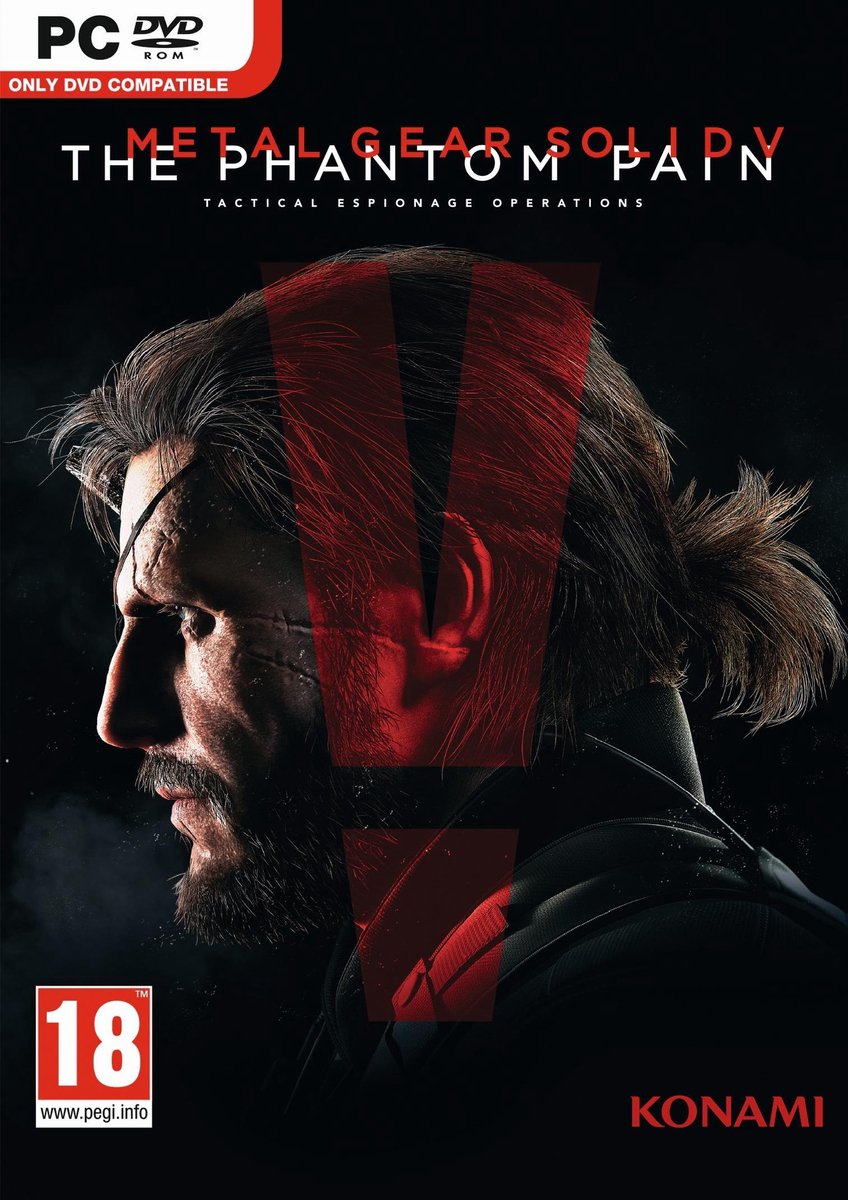
Metal Gear Solid V: The Phantom Pain (2015) swaps corridors for open bases. You scout with binoculars to mark guards before you go in, and if you are spotted, Reflex Mode slows time for a moment so you can recover. It teaches the scouting habit: look first, move second.
Quick answers
Why do guards spot me when they aren't looking at me?
Usually it's the edge of their view or noise: many games give guards slower-filling peripheral vision and let them hear you run.
How long should I watch a guard before moving?
At least one full loop, from one stop all the way back to the same stop.
Is it better to sneak or run past a guard?
Sneak when the safe window is long, and run only when it is short and the guard is far away.
Your next step: next time you load a stealth level, pick one guard and time his loop from one stop back to the same stop before you take a single step.
Loadout · gear used
Affiliate links, marked sponsored. We may earn a commission at no extra cost to you. Examples that match this guide, not tested reviews. Prices checked 27 Oct; every shop and live prices are on each product page.