No, you don't need Hollow Knight to understand Silksong. But if you're new to metroidvanias, Hollow Knight is the gentler place to learn the same skills.
Silksong has its own hero and kingdom, so the story stands alone. It is the sharper test, though: ordinary enemies take two masks per hit early on, healing is all-or-nothing, and the pace is faster. Compare where each game's difficulty comes from in our side-by-side breakdown, see which skills carry over, learn the one healing habit Hollow Knight players must change, and find out who should start where.
▶ Interactive · Should you play Hollow Knight before Silksong?
No, you don't need to play Hollow Knight before Silksong: Silksong has its own hero, its own kingdom and its own story. But if you have never played a metroidvania, Hollow Knight is the gentler place to learn, because it teaches the same core skills with less pressure. Silksong is the sharper test from its first hours. Which one to pick depends on what you want more: the newest game now, or an easier on-ramp.
A quick definition: a metroidvania is a side-on action game set in one big connected map, where new movement abilities open paths you couldn't reach before. Both games are made by the small Australian studio Team Cherry. Hollow Knight came out on PC in 2017; Silksong launched on 4 September 2025 on PC, PlayStation, Xbox and both Switch consoles.
Do you need it for the story?
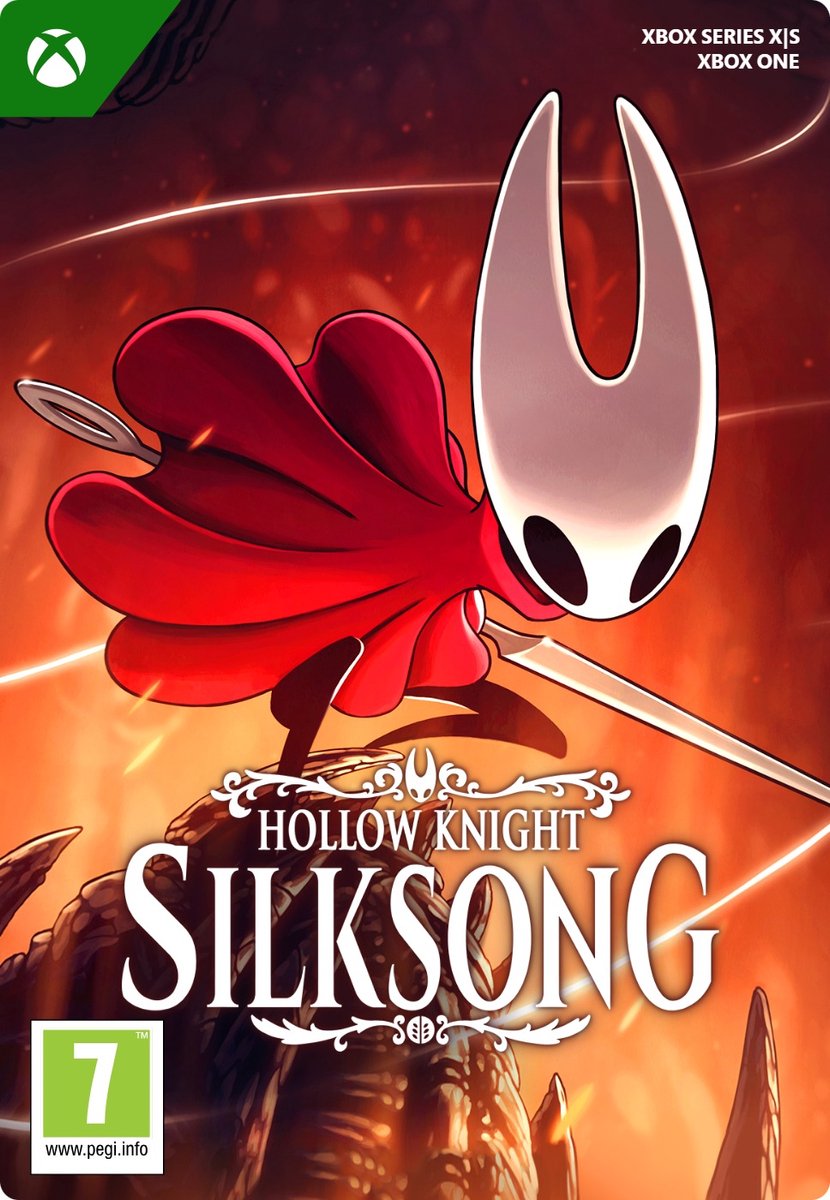
Not really. Silksong is a sequel, but you play as Hornet, a character from the first game, in a new kingdom called Pharloom rather than Hollow Knight's Hallownest. Nintendo Life's guide notes the story makes few big references to the first game. You'll recognise Hornet faster if you played Hollow Knight, and that's about it.
Where the two games are hard
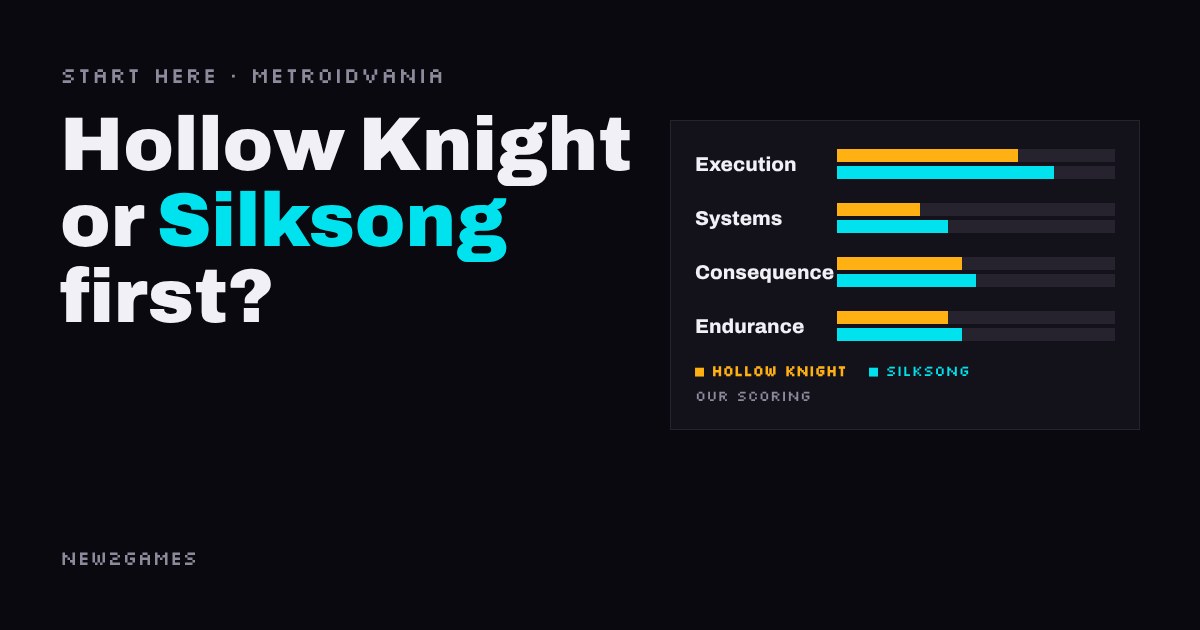
On this site we don't give games a single difficulty score. We describe difficulty by its sources: Execution (timing and precision), Systems (builds and how items interact), Consequence (what dying costs you), Endurance (length and attrition) and Competition (other players). Both games are mostly an Execution test. Silksong turns most of the dials up a little. Tap a row to see why.
The two biggest jumps are in Execution and Systems. In Silksong, lots of ordinary enemies take two masks (health points) per hit from early on, something players complained about within a day of launch; in Hollow Knight, players point out, that was mostly saved for late bosses and big, slow attacks. Team Cherry's first patch softened two early bosses and made some travel cheaper, but the overall shape stayed the same.
What carries over, and the one habit to change
Almost everything Hollow Knight teaches is used again in Silksong, which is why it works as a first step:
Reading enemy patterns: watching a boss's wind-up and learning which attacks leave a gap to hit back.
Bouncing off things with a downward strike (called a pogo), which both games use for platforming and fights.
Reading the map and remembering the ledge you couldn't reach an hour ago.
The corpse run: when you die, you leave something behind at the spot (a Shade holding your money in Hollow Knight, a silk cocoon holding your Rosaries in Silksong). Die again before you get back and that money is gone.
The habit to change is how you heal. In Hollow Knight, Focus spends 33 Soul to heal one mask at a time, so topping up a single lost mask is normal. In Silksong, Bind uses your whole starting spool of silk to heal three masks at once, and a hit before it finishes wastes all of that silk. Healing when you're only one mask down throws most of it away. Hollow Knight players have to learn to wait for a bigger, safer opening.
Silksong also moves faster. Hornet is quicker than Hollow Knight's hero, and the challenge ramps up sooner. That's not a skill you build so much as a pace to get used to: Hollow Knight rewards patience, and Silksong asks you to act sooner.
Who should start where
Start with Hollow Knight if
Start with Silksong if
This is your first metroidvania
You've finished a tough action game before
You want a slower ramp
You mainly want the new game now
You like knowing the world first
You don't mind dying a lot early
The case for starting with Hollow Knight is mostly about teaching order: it introduces each skill at a calmer pace, so by the time Silksong asks for all of them at once, you already have them. The fair counter-argument is that Silksong's skills can be learned in Silksong, plenty of players start there, and the first game is a long commitment if you only care about the new one. If you try Silksong first and keep dying to the same boss, practise that one fight on its own, the way you'd practise the hardest section of a retro level.
Next step: if you're new to the genre, play Hollow Knight up to its first few bosses. If you're enjoying it, finish it and then move to Silksong, ready for its faster pace.
Quick answers
Do I need to play Hollow Knight to understand Silksong?
No: Silksong has a new hero, a new kingdom and few big references to the first game.
Is Silksong harder than Hollow Knight?
Yes, mostly in Execution: enemies hit harder earlier, and healing is all-or-nothing.
Can I play Silksong first and go back to Hollow Knight later?
Yes; the first game will feel a bit slower and gentler, which is fine.
Loadout · gear used
Affiliate links, marked sponsored. We may earn a commission at no extra cost to you. Examples that match this guide, not tested reviews. Prices checked 26 Oct; every shop and live prices are on each product page.