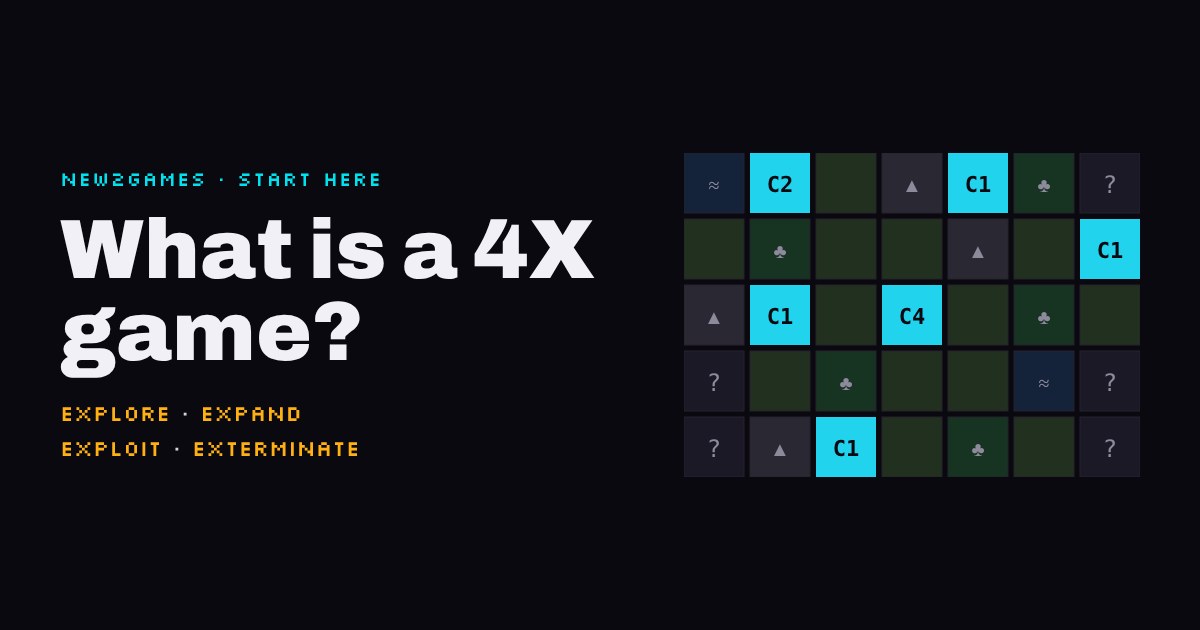
A 4X game is a strategy game where you explore a map, expand by founding cities, exploit the land and exterminate or outlast rivals, usually turn by turn.
This first-timer's guide explains where the name came from, lets you play the explore-expand-exploit loop in a 20-turn toy, and shows what makes the genre hard: lots of systems and long games, but almost no reflexes. Then it suggests where to start, from a 30-turn game of Polytopia to Civilization VI, with an honest look at Civilization VII.
▶ Interactive · What is a 4X game? A first-timer's guide
A 4X game is a strategy game where you build an empire on a map: you explore it, expand by founding cities, exploit the land for resources and exterminate (or outlast) your rivals. Most are turn-based, so nothing happens until you end your turn, and one game can run for hours across hundreds of turns. If you want a first one, start small with The Battle of Polytopia, or go straight to Civilization VI.
That last part needs some explaining, and so does the genre. 4X games have a reputation for being "too much", and it's partly deserved, but the reason they feel heavy isn't the reason most people expect. You don't need fast hands. You need to get used to a slow, compounding kind of thinking, and that can be learned.
Where the name comes from
The term was coined by the writer Alan Emrich in a 1993 Computer Gaming World preview of the space strategy game Master of Orion. He gave it an "XXXX" rating, a joke on film ratings, standing for explore, expand, exploit, exterminate. The label stuck for the whole family of empire-building games, from the Civilization series to space and fantasy games built the same way.
The four Xs, in the order you meet them
Explore. You start with one settlement and a map hidden under fog, a dark layer that covers everything you haven't seen yet. Sending a scout out isn't wasted time: you can't settle land you haven't found.
Expand. You found more cities. This is the decision that shapes the early game, because every city you add earns something every turn for the rest of the game.
Exploit. You grow what you have: buildings, farms, research. Here "exploit" just means making the land pay, not cheating. Most 4X games have a tech tree, a branching list of discoveries where each one unlocks the next.
Exterminate. Sooner or later you meet other empires. War is one answer, but most modern 4X games also let you win peacefully, through science, culture or diplomacy, and you can play a whole game as a builder who only fights when attacked.
Feel the loop in 20 turns
The toy below is the explore-expand-exploit loop with everything else stripped out. You get one action a turn. Try two games: first, only grow your capital. Then restart and spend the early turns exploring and founding cities before you grow anything. Watch the Income box.
If you tried both, you felt the main idea of the genre. A new city looks expensive on the turn you pay for it, but it earns every turn after that, so cities founded on turn 3 are worth far more than cities founded on turn 15. That's called snowballing: an early lead that grows on its own. Exploring felt like a wasted turn until it uncovered space for new cities. And once the land ran out, growing the cities you had became the best move. Real 4X games add war, science and diplomacy on top, but this rhythm of spending now to earn later is underneath all of them.
What makes a 4X hard (and what doesn't)
On this site we describe difficulty by where it comes from, not with one score. Here's our scoring for the genre as a whole, against the AI on a normal difficulty level:
Source
In a typical 4X
Systems
High: many rules that affect each other
Endurance
High: long games, slower late turns
Consequence
Medium: early mistakes grow slowly
Competition
Low vs AI, high online
Execution
Almost none: no timing or reflexes
That's the good news for a newcomer. Execution, the reflex and timing difficulty that makes shooters and fighting games hard to pick up, is almost absent. The clock waits for you. What's hard is systems (cities, terrain, research and diplomacy all feed each other) and endurance: as your empire grows you have more cities to manage, so late turns get slower. A bad early choice also costs you slowly rather than instantly, which makes it hard to see what went wrong. The fix is to play an easier difficulty level and a smaller map for your first game; Civilization and most other big 4X games offer both.
A habit to watch: if you come from real-time strategy, where speed wins, you'll want to click through turns fast. Turn-based 4X games reward the opposite: take the time to look at the map before you end a turn. For how economy decides real-time games instead, see workers or army? How economy wins RTS games.
Where to start
4X splits into a few families that don't compare well with each other: historical games (Civilization), space games (Master of Orion, Stellaris), fantasy games, and small "pocket" 4X games built for short sessions. Here are two good first steps, in the order we'd play them.
The quick taste: The Battle of Polytopia
The Battle of Polytopia (Midjiwan, 2016) is free to download on phones, with extra tribes sold separately, and also on PC and Switch. Its Perfection mode gives you a 30-turn limit to score as many points as you can, so a game fits in a coffee break. It carries the same loop as the toy straight into a bigger game: find land, settle it early, then grow what you have. It's simplified, and that's the point.
The full game: Civilization VI or Civilization VII?
Both are historical 4X games from the same studio, played the same way against the AI, so they are fair to compare. Our case for Civilization VI as the first one: it came out in 2016, it's on PC, consoles and phones, and you play one civilization from start to finish, so a whole game tells one story. Its cities spread over the map in districts (separate tiles for science, trade and so on), and its "eureka" boosts speed up a discovery when you do something related to it on the map, so exploring and building feed your research. Years of guides and videos exist for nearly every question you'll have.
The strongest counter-argument is Civilization VII (February 2025, PC and consoles, later Switch 2). It breaks a game into three ages, antiquity, exploration and modern, which gives you natural stopping points, and critics found several of its systems simpler. But reviewers also said its interface explains very little, players disliked the abrupt jumps between ages and having to switch civilization at each one, and its Steam user reviews were mixed. The free Test of Time update in May 2026 added a way to keep one civilization for the whole game, which removes the biggest complaint. If you'd rather play the newest game and don't mind looking things up, it's a reasonable first pick; we still think VI is the easier teacher.
Who 4X is for: players who enjoy planning, like watching something they built grow, and are happy with a game that takes several evenings. Who might skip it, or start with Polytopia: anyone who wants action from minute one, or only has short sessions.
Play one Perfection game of Polytopia tonight and pay attention to the turn where you stop founding cities. If that loop clicks, start Civilization VI on a small map and a low difficulty level, and give it two evenings before you judge it. Already know you like runs more than empires? Read what is a roguelike? instead.
Quick answers
What does 4X stand for?
Explore, expand, exploit and exterminate: the four things you do to build an empire in these games.
Are 4X games hard for beginners?
They're heavy on rules and long, but they need no reflexes, and an easy difficulty level on a small map makes a first game very manageable.
Is Civilization a 4X game?
Yes, the Civilization series is the best-known historical 4X, and most people's first one.
Loadout · gear used
Affiliate links, marked sponsored. We may earn a commission at no extra cost to you. Examples that match this guide, not tested reviews. Prices checked 3 Nov; every shop and live prices are on each product page.