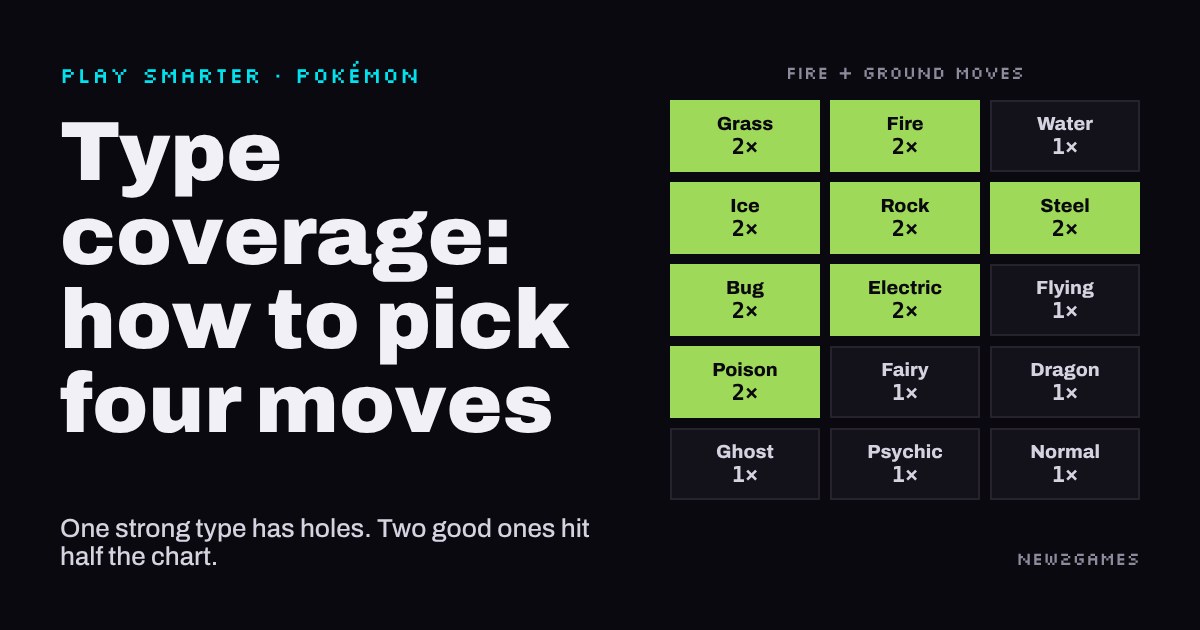
Pick moves for what they cover together: as many types hit super effectively as possible, and none that resist every move you have.
A plain guide to type coverage in Pokémon: why one strong type always has holes, how a second type fills them, why even Fire, Water and Grass leave Dragon untouched, and a four-step way to choose your four moves, with an interactive coverage checker you can try with your own team.
▶ Interactive · Pokémon type coverage: how to pick four moves
Pick moves for what they cover together, not one by one: between your four moves, you want as many types as possible hit super effectively and none that shrug off every move you have. In practice that means one or two moves that share your Pokémon's own type, then one or two from other types chosen to cover the gaps those leave. A single strong type always has holes; two well-matched types can hit half the chart hard.
Every Pokémon and every move has a type, and there are 18 of them. When a move lands, the game compares the move's type with the target's: a super effective hit does double damage (2×), a resisted one ("not very effective") does half (½×), and some matchups do nothing at all (0×, an immunity). Because a Pokémon can only know four moves at a time, you can't carry an answer to everything. The skill is choosing four that cover for each other. Players call this coverage.
Why one strong type isn't enough
Take a Fire-type with nothing but Fire moves. Fire is super effective against 4 types (Grass, Ice, Bug and Steel) but is resisted by 4 others: Fire, Water, Rock and Dragon. Against those four you are doing half damage every turn, and switching your Pokémon out is often the only fix.
Now add a single Ground move. Ground is super effective on Fire and Rock, two of the types that resist Fire, so the pair hits 8 of the 18 types hard, and no single type resists both. That is the whole idea of coverage: the second move earns its slot by covering the first move's weak spots, not by being strong on its own. Try it below.
Start with "Fire" and look at the amber tiles. Then tap Ground in the move list (or press "Fire+Ground") and watch them turn. Try "Starter trio" too: Fire, Water and Grass sound like they cover everything, but Dragon resists all three, and the tool shows it as the one amber tile left.
Read the chart as gaps, not wins
Beginners tend to count super effective matchups. The more useful count is the other one: how many types resist or ignore everything you have. A move that is merely neutral (1×) still does real damage; a type that resists all four of your moves is where a battle stalls.
Some numbers from the chart, counted with the tool above:
Move types
Super effective on
Normal
0 types
Fighting or Ground
5 types
Fire + Ground
8 types
Ice + Ground
9 types
No single type is super effective on more than 5 of the 18, so coverage is always a team effort between moves. Watch the immunities too, because they are where a "good" move does nothing: Ground ignores Electric, Ghost ignores Normal and Fighting, Flying ignores Ground, Dark ignores Psychic, Steel ignores Poison and Fairy ignores Dragon.
A simple way to pick four moves
Start with your own type. A move that matches one of the user's types gets a 1.5× bonus, called STAB (same-type attack bonus). One strong STAB move per type your Pokémon has is the usual backbone.
Find what walls it. Look at which types resist your STAB move. Those are the types your next move should hit.
Add the type that turns those walls green. Ground fixes Fire's problems with Fire and Rock; Ice fixes Ground's problem with Flying, which is immune to it.
Keep a slot for something that isn't damage if your Pokémon has a useful status or healing move. Four attacks are not automatically better than three and a good utility move.
There is a real trade-off in step 3. A coverage move doesn't get STAB, so against a neutral target it hits for 1× while your STAB move hits for 1.5×. But a super effective hit without STAB (2×) still beats a neutral one with it, at the same move power. Coverage pays off exactly where your main type is weak, which is the point.
Where the simple picture gets messier
Dual types multiply. Many Pokémon have two types, and a move's multipliers against each are multiplied together. A Grass/Flying Pokémon takes 4× from Ice (weak on both counts), and a Bug/Grass one takes only ¼× from Ground. The tool above shows single types to keep it readable; against a dual type, check both halves.
Types can change mid-battle. In Pokémon Scarlet and Violet, Terastallizing switches a Pokémon's defensive type to its Tera Type, so a matchup you planned around can flip. If the Tera Type matches one of the Pokémon's original types, its STAB rises from 1.5× to 2×.
Coverage isn't everything. A coverage move your Pokémon is bad at using (an attacker built for physical moves carrying a special one, say) or one with poor accuracy can be worse than a neutral STAB hit. Treat the chart as the first filter, not the final answer. The same "fewer, better options" thinking shows up in trimming a deckbuilder deck: every slot you fill is a slot something better can't use.
Who this is for
This is for anyone playing a main-series Pokémon game who keeps hitting a wall with a favourite Pokémon, or who has started to wonder which four moves to keep when the game asks you to forget one. If you already plan teams for online battles, you know this; the next step for you is speed, abilities and dual-type matchups, which this page leaves out.
Next step: if you're playing Pokémon Scarlet or Violet, open your lead Pokémon's moves, put its types into the tool above, and find the one type that resists everything it has. That's the slot your next TM should fill.
Quick answers
Should all four moves be different types?
Usually, but not always: two moves of your main type can make sense if one is stronger and one is more accurate or has a useful effect.
Is a super effective move always better than STAB?
At equal power, a super effective hit (2×) beats a neutral STAB hit (1.5×), but against neutral targets your STAB move does more.
What is the most important matchup to remember?
The immunities, because a 0× move wastes your whole turn: Ground ignores Electric, Ghost ignores Normal and Fighting, Flying ignores Ground, Dark ignores Psychic, Steel ignores Poison and Fairy ignores Dragon.
Watch it done
4 videos from other creators on this, picked and annotated by us.
Affiliate links, marked sponsored. We may earn a commission at no extra cost to you. Examples that match this guide, not tested reviews. Prices checked 8 Nov; every shop and live prices are on each product page.
The game this guide uses for its Terastallizing example: Tera Types can change a Pokémon's defensive type mid-battle, so coverage plans need a second look.