Gran Turismo 7 - PS5
Its driving line can mark braking areas on track, and the early licence tests drill stopping on a line before corners.
- PS5, disc
- Braking-area guides
- Licence tests
€40.99
bol.com ↗
specs, all 3 shops ▸
Your braking point is where you must start braking to reach the corner's top speed exactly at turn-in. Find it with a fixed marker: brake early, then a little later each lap.
Braking distance grows with the square of your speed, and less grip moves the point earlier again, so a point that works in one car or in the dry is wrong in another. Try it in our one-corner braking toy, then use the six-step marker method on a real track, with tips for using the braking guides in Gran Turismo 7 and Forza Motorsport without leaning on them forever.
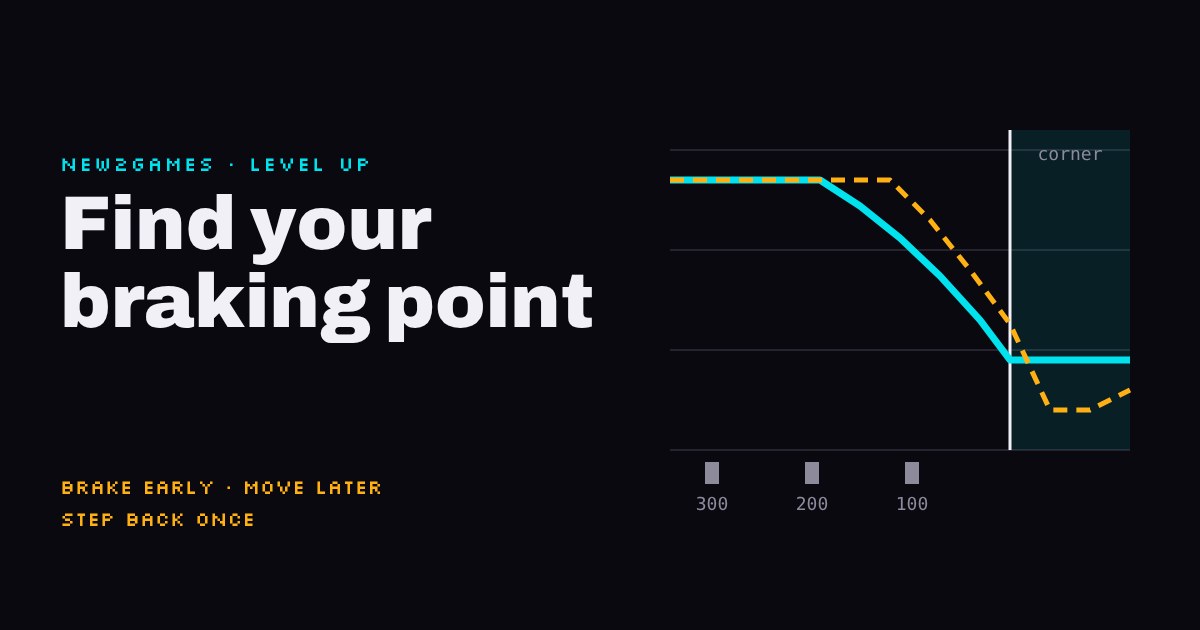
Your braking point is the spot where you have to start braking so the car is slowed to the corner's top speed exactly as you turn in. You find it the same way in almost any racing game: pick a fixed marker you can see from the straight, brake there while it still feels too early, and move it a few metres later each lap until you start running wide. Then step back once. That spot is your braking point for this car, this speed and this grip.
That sounds like a lot of laps for one corner, and at first it is. But the method carries over to every track and every car you will ever drive, so it is worth learning once, properly.
On a straight, everyone is fast: you hold the accelerator and the car does the work. The corners are where drivers separate, and the corner is decided before you turn the wheel. If you arrive too fast, the tyres can't hold the line, the car drifts toward the outside of the corner and you have to wait before you can accelerate again. If you arrive too slow, you simply roll toward the corner at a pace you didn't need to be at.
Two pieces of physics shape everything else:
Braking distance grows with the square of your speed. Arrive twice as fast and you need roughly four times the distance to shed the same speed. So a braking point that works at one speed is wrong at another, even on the same corner.
Grip sets how hard you can slow down. On a wet track, on cold or worn tyres, or in a car with weaker brakes, the same corner needs an earlier braking point, and the corner itself has a lower top speed.
In driving terms, braking mostly tests execution, one of the five sources of difficulty we use on this site: precision and timing, not knowledge. It is also a skill that rewards a bit of patience, because the fastest way to learn it is to start slower than you think you need.
The toy below is one corner seen as a speed graph: you come down a straight, brake, and turn in at the vertical line. Move the brake marker and watch what happens to your corner entry speed and your time. Start where it is set, comfortably early, and move it later in small steps. Then change the speed or make the track wet and do it again.
A few things the toy shows that are true of real driving too. At 150 km/h in the dry, the best point in our model is about 56 m before the corner. At 220 km/h it is about 155 m, nearly three times as far, for a speed only about one and a half times higher. Make it wet and the 220 km/h point moves back to roughly 257 m. And mistakes are not symmetrical: in our model, braking 10 m too late costs about two to three times as much time as braking 10 m too early, because a late brake also ruins your exit from the corner.
The slider goes the "wrong" way on purpose. A bigger number means braking earlier, further from the corner, which is how braking points are usually counted.
1. Pick one corner and one car. Your braking point only means something for a fixed car, speed and grip. Change the car and you start again (though much faster the second time). A heavy, fast corner at the end of a long straight is the best place to learn, because the braking zone is long and easy to see.
2. Choose a marker you can see at speed. Many circuits have countdown boards before big corners, often labelled 300, 200 and 100. If there are none, use anything fixed: a kerb, a sign, a patch of tarmac, the start of a barrier. A shadow or another car doesn't count, because it won't be there next lap.
3. Start early on purpose. Brake at a marker that feels comfortably too early, and brake firmly in a straight line. You want to arrive at the corner too slow. That lap tells you nothing is going wrong yet, which is the point.
4. Move later in small steps. Each lap, brake roughly a car length later (a few metres). Don't jump: a big change makes it impossible to tell which lap was the good one.
5. Stop when the corner pushes back. The first lap where you run wide, need to brake again in the corner, or can't get on the power when you want to, you have gone one step too far. Step back once. That is your braking point.
6. Re-find it when anything changes. Rain, a car with more speed on the straight, worn tyres in a longer race, or a slipstream that gives you extra speed: all of them move the point earlier.
| What you feel | What it usually means |
|---|---|
| Running wide at turn-in | Braking too late |
| Waiting to turn in | Braking too early |
| Wheels lock, car slides | Brake pressure too high |
| Fine in dry, off in wet | Same marker, less grip |
This skill belongs to the grip-and-precision side of racing games: sims and "sim-cade" games where the car behaves roughly like a real one. In arcade racers built around drifting through corners at full speed, braking points matter much less, and that is a different kind of hard. If you come from those games, the habit to watch is turning in at full speed and hoping the car sorts it out. A grip racer will punish that, so expect the first few sessions to feel slow.
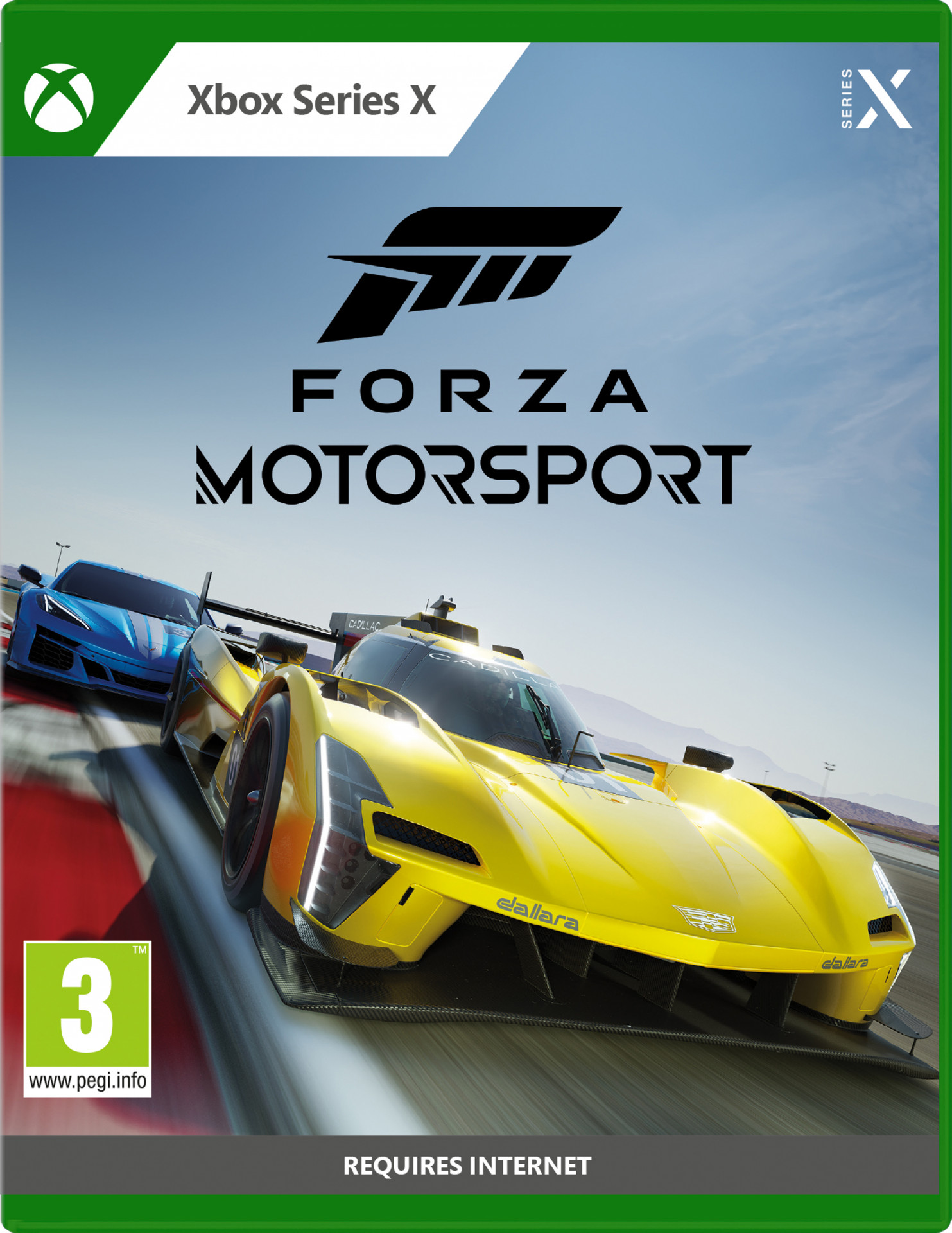
Two good places to learn it both have on-screen help you can lean on and then switch off. Gran Turismo 7 (PS5 and PS4) can show a driving line with braking areas marked on the track, and the first National B licence tests drill starting and stopping before you get to corners. Forza Motorsport (Xbox Series X|S and PC) has a Suggested Line setting with a "Braking only" option that draws just the braking zones in red.
Use those guides to find roughly where a zone starts, then pick your own marker there and turn the guide off. If you keep the line on forever you learn to react to a red stripe, not to the track, and the stripe isn't there in every game. Keeping ABS (anti-lock brakes, which stop the wheels from locking when you press hard) switched on while you learn is fine: it lets you brake firmly without the car sliding, so you can focus on where you brake.
Playing on a controller? Your trigger travel and steering settings change how precisely you can brake and turn in; our guide to controller steering settings for racing games covers the steering side.
Only up to your braking point; past it you arrive too fast, run wide and lose more time on the exit than you gained on the straight.
Less grip means the tyres can't slow the car as hard and the corner holds a lower speed, so you need to start braking earlier.
Use it to find roughly where each braking zone starts, then pick your own marker and switch it off.
Next step: pick the slowest corner after the longest straight on one track, set your marker comfortably early, and spend ten laps moving it later one car length at a time.
Its driving line can mark braking areas on track, and the early licence tests drill stopping on a line before corners.
The Suggested Line can show only the red braking zones, a handy way to find where a zone starts before you pick your own marker.