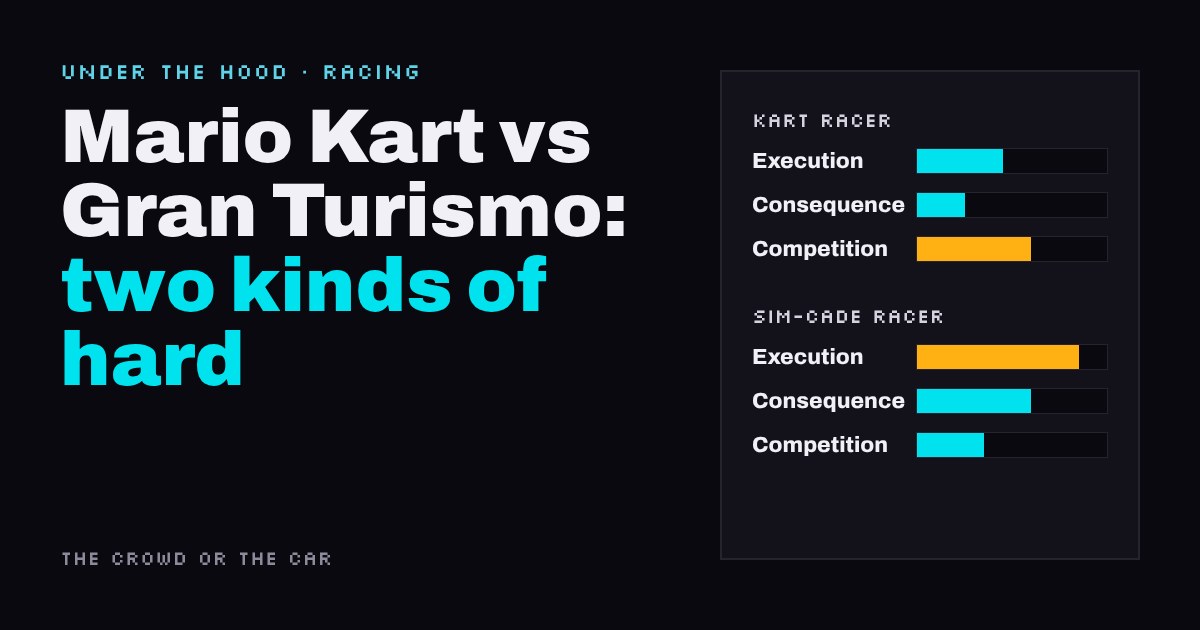
Neither is simply harder: Mario Kart is hard because of the crowd and its items, Gran Turismo because of the car, where a mistake costs places for good.
A plain look at why a kart racer and a sim-cade racer don't belong on one difficulty list. With a side-by-side of Mario Kart World and Gran Turismo 7 across five sources of difficulty, with and without assists, what the item system and the driving aids really change, and which skills carry over when you move from one to the other (and which habits to unlearn first).
▶ Interactive · Mario Kart vs Gran Turismo: two kinds of hard
Neither is simply "harder". They are hard for different reasons. Mario Kart's difficulty comes mostly from the other racers: a crowded field and items that can reshuffle the order in the last corner. Gran Turismo's comes mostly from the car: braking, throttle and grip, where one mistake costs places and nothing hands them back. That's why being good at one doesn't make you good at the other, and why they don't belong on the same difficulty list.
On this site we describe difficulty by its sources (execution, systems, consequence, endurance and competition) instead of one score. Put these two games through that lens and the gap stops being mysterious.
Two different jobs behind the wheel
Mario Kart World (Nintendo Switch 2, June 2025) puts up to 24 drivers on track. Your job is to drive well and survive the crowd: dodge shells, hold an item to block the one behind you, pick the moment to use a boost. Driving matters, especially drifting into a mini-turbo (a short speed boost you charge by holding a drift), but the field is the bigger variable.
Gran Turismo 7 (PS4 and PS5, 2022) gives you a car that behaves like a car. Your job is to brake at the right point, turn in, and get back on the throttle without spinning the rear tyres. The other cars matter, but most of the time the thing beating you is your own braking point. (New to that idea? Our guide on finding your braking point starts there.)
This is the rule behind every comparison on new2games: you can only rank games against each other when they share a subgenre and a kind of difficulty. A kart racer and a sim-cade racer (a game that models real car handling but stays playable on a controller) share neither, so "which is harder" has no single answer. What you can do is compare their shapes.
Compare the shapes
Pick a game and switch the assists on or off. The bars are our scoring on a 0–100 scale, one bar per source of difficulty; the thin mark on each bar shows the other game with the same assist setting, so you can see where they differ.
Two things stand out. Mario Kart's tallest bar is Competition; Gran Turismo's is Execution. And the assists in both games mostly lower Execution and Consequence. They make the car easier to keep on the road; they don't change what the game is asking of you.
Why Mario Kart is hard: the crowd and the items
Mario Kart items are handed out by where you are in the race. A fan analysis of Mario Kart World, reported by NintendoSoup, found that item odds depend on your position rather than on your distance from the leader (Mario Kart 8 Deluxe used distance), and that players get stronger items overall than in older games. The blue Spiny Shell homes in on whoever is in first. The leader is always the target.
That's the source of the famous "I was first all race and finished sixth". It isn't bad driving; it's the design. Mario Kart deliberately keeps the race close so that a group of friends with different skill levels all stay in it. For a newcomer this is the good news: Consequence is low, because a mistake costs you a few seconds and the next item box can win them back. The Knockout Tour mode, where checkpoints cut the field from 24 down to the last few, turns the same pressure up rather than adding a new kind.
The assists go further. Smart Steering stops you falling off the course, and Auto-Accelerate means you don't hold the gas button. Both are in the control options and can be turned off whenever you like.
Why Gran Turismo is hard: the car
In Gran Turismo 7 nothing reshuffles the order for you. If you brake too late, lock a wheel or spin on the exit of a corner, the places you lose stay lost. That's high Consequence on top of high Execution. Endurance rises too, because learning where to brake on a new track takes lap after lap of practice.
The game's assists are generous, though. Traction control stops the tyres spinning when you accelerate, ABS stops them locking under braking, active stability management and countersteering assistance catch slides, and the driving line and braking markers show where to slow down. There's even an auto-drive option. Turned on, they bring the Execution bar down a long way; turned off, they leave you alone with the car.
Competition is lower than many expect. Most of the game is you against the AI and the clock. The online Sport mode is where other people matter, and it is built to be clean rather than chaotic: you are rated on both speed (Driver Rating) and clean racing (Sportsmanship Rating), and contact, cutting the track or hitting walls can cost you rating and earn time penalties.
Moving from one to the other
On our skill map, the step from Mario Kart to Gran Turismo is a hazard edge: some skills carry over, but some habits have to be unlearned first.
Carries over
Unlearn first
The racing line: wide in, clip the inside, wide out
Contact as a tool: in Sport mode it costs rating
Looking ahead to the next corner
Drifting every bend: in GT7 a slide usually costs time
Learning a track's shape
Expecting a comeback: no items, no catch-up
Braking is the big gap. Mario Kart barely asks you to brake, so it doesn't train the one skill Gran Turismo leans on most. Going the other way is gentler: a Gran Turismo player usually drives clean Mario Kart lines quickly, and then has to learn that a clean line doesn't protect you from a red shell.
Moving to Gran Turismo on a controller? Our guide to controller steering settings covers the settings that make fine corrections easier. If you've wondered whether racing AI cheats to keep up, our sister site explains rubber banding, which is a different trick from items.
Which one should you play?
Want racing as a night with friends, where anyone can win and a bad lap doesn't end your race? Mario Kart World, with Smart Steering on for anyone who has never raced before.
Want the quiet satisfaction of a lap that is faster because you braked better? Gran Turismo 7, with the assists on to start. Turn them down one at a time (traction control last) as your laps get consistent.
Quick answers
Is Gran Turismo harder than Mario Kart?
It is harder to drive well, while Mario Kart is harder to control the outcome of; they're hard in different ways.
Does being good at Mario Kart help in Gran Turismo?
Partly: racing lines and track reading carry over, but braking doesn't, and bumping and drifting habits need unlearning.
Should a beginner turn on the assists?
Yes in both games; they lower the execution load without changing what each game is teaching you.
Next step: if you play Mario Kart, try one race with Smart Steering off and notice where you naturally lift off the gas. Those corners are your first braking points in any other racing game.
Loadout · gear used
Affiliate links, marked sponsored. We may earn a commission at no extra cost to you. Examples that match this guide, not tested reviews. Prices checked 24 Nov; every shop and live prices are on each product page.