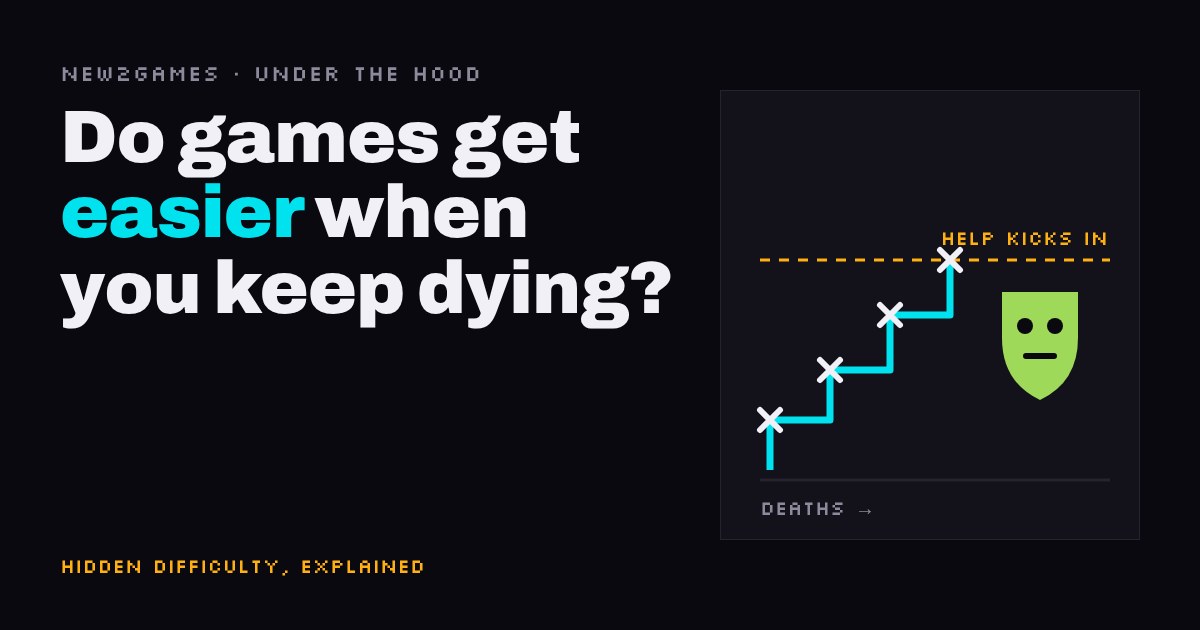
Sometimes: a few games quietly help after you struggle, like Crash Bandicoot's free mask or Resident Evil 4's hidden grade. Most games don't adapt at all.
This explainer shows the four shapes of dynamic difficulty: help after deaths, a hidden performance grade, Left 4 Dead's pacing Director and Mario Kart's position-based items. A toy model lets you die, get hit and win fights to see what each system actually tracks, which kind of difficulty it softens, and how to tell whether the game got easier or you got better.
▶ Interactive · Do games get easier when you keep dying?
Sometimes, yes, and it is rarely announced. A handful of well-known games quietly change things after you struggle: the first Crash Bandicoot hands you a protective mask and extra checkpoints after repeated deaths, and the original Resident Evil 4 keeps a hidden grade of how well you are doing. Most games don't do this at all, though, and some systems that look like "the game went easy on me" are about pacing, not about you.
This is worth knowing for two reasons. It explains why a fight sometimes feels different on the tenth try. And it tells you when the improvement is the game, and when it is you.
Four ways a game can quietly help
Game designers call the general idea dynamic difficulty adjustment (DDA): the game watches how you are doing and changes something in response. It comes in very different shapes.
Help after deaths
The cleanest example is the first Crash Bandicoot (1996). In his 2011 series on making the game, Naughty Dog co-founder Andy Gavin describes three tricks: if you kept dying, the game started you with an Aku Aku mask (which absorbs one hit), slowed the rolling boulder a little each time it caught you, and turned a nearby crate into a checkpoint. The goal, the series explains, was to help weaker players without changing the game for stronger ones. The 2017 remake, the N. Sane Trilogy, keeps the same ideas in the first game, according to a fan site that catalogues the changes.
A hidden grade
Resident Evil 4 (2005) keeps a secret score of your performance. The official strategy guide described it as a grade from 1 to 10; on Normal you start at 4 and move roughly between 2 and 7, and the grade changes how aggressive enemies are and how much damage they deal (summarised on Wikipedia). Play well and the villagers hit harder; die and they ease off. Capcom never advertised it, which is why many players only learned about it years later. We could not confirm whether the 2023 remake works the same way, so we make no claim about it.
A pacing director
Left 4 Dead's "AI Director" is often described as adjusting difficulty, but Valve's own 2009 conference slides show it is mostly a pacing system. Each survivor has an "intensity" value that rises when you take damage, get knocked down, or kill zombies close by. When the team's intensity gets too high, the Director pulls back the hordes and special zombies for a while, then lets the pressure build again. A struggling team does get breaks, but because it is stressed, not because the game graded its skill. Boss zombies are not affected.
Help by position
Kart racers help whoever is losing the race. In Mario Kart 8 Deluxe, the odds inside each item box depend on your place, and the most powerful items go mostly to drivers near the back (Mario Wiki keeps the tables). That is not about your skill at all, just your position. Racing AI that speeds up or slows down to stay close is a related trick; new2gaming explains it in What is rubber banding?.
Press the same buttons in each mode and watch what the game is actually tracking. In "Death help", only deaths count, and a clean run to the checkpoint wipes the slate. In "Hidden grade", doing well pushes the line up and makes enemies meaner. In "Pacing", even clean fights raise the line, because killing zombies up close is stressful too, and the Director backs off when the line peaks whether you were winning or losing.
Which kind of hard does it change?
On this site we describe difficulty by its sources, not as one number. The four systems above touch different ones:
System
Source it softens
Death help (Crash)
Consequence, a bit of Execution
Hidden grade (RE4)
Execution, both ways
Pacing (Left 4 Dead)
Endurance
Position (Mario Kart)
Competition
Consequence is what failure costs you, Execution is timing and precision, Endurance is attrition over a long stretch, and Competition is difficulty that comes from other players. Notice that none of these systems teaches you anything. A mask lets you survive one mistake; it doesn't fix the jump you missed.
Why games keep it secret
The argument for hiding it is about how success feels. Gavin says Crash players never realised they were each playing a slightly different game, and that eventually everyone got through it. If a pop-up said "we made this easier for you", plenty of players would feel patronised and switch it off, or feel the win wasn't theirs.
The fair counter-view: some players do feel cheated when they find out, and a hidden system can punish you for playing well. In RE4, a confident player gets tougher enemies without ever choosing that. There is also the trust problem: once you know a game might adapt, you can never be quite sure what you beat.
Is it you or the game?
Most games, including most hard action games, don't adapt at all. The fight on attempt ten is the same fight as on attempt one. If it suddenly goes well, the usual explanation is that you learned it: you recognise the attack before it lands and you stopped panicking. That is the normal shape of practice, and our guide to beating a hard retro level without save states is about exactly that curve.
Signs the game is helping: something you can see changes (a free shield, a checkpoint that wasn't there, an obstacle moving slower), or the help shows up right after a string of deaths. Signs it is you: nothing on screen changed, but you are reacting earlier and making fewer mistakes.
If you would rather have help out in the open, look for games that offer it as a choice. Celeste's Assist Mode, for example, lets you slow the game down, give yourself infinite stamina or extra air dashes, or turn on invincibility, and you decide when. That is the same idea as DDA, except you are the one turning the dial.
Next step: if you want to feel a hidden helper at work, play the first game in Crash Bandicoot N. Sane Trilogy, find a jump that keeps catching you, and count your deaths until the mask shows up.
Quick answers
Do games get easier if you die a lot?
Some do, such as the first Crash Bandicoot, but most games stay exactly the same and the improvement is your own practice.
Does Resident Evil 4 have dynamic difficulty?
The original 2005 game does: a hidden grade raises or lowers enemy aggression and damage based on how you play.
Does Left 4 Dead's AI Director make the game easier?
It mainly controls pacing, giving the team a breather after intense moments rather than rating your skill.
Loadout · gear used
Affiliate links, marked sponsored. We may earn a commission at no extra cost to you. Examples that match this guide, not tested reviews. Prices checked 31 Oct; every shop and live prices are on each product page.