When you're stuck in a point-and-click adventure, stop trying every item on every object. Write down exactly what is blocking you, re-read what the game has already told you, and then take the smallest hint that gets you moving: a nudge, not the walkthrough. Most "impossible" puzzles fall to one of those three steps.
Point-and-click adventures are games where you explore scenes with a cursor, talk to characters, collect items and use them to get past obstacles. The classics mostly date from the late 1980s and 1990s, and the genre is still alive in remasters and new indie games. If you grew up on action games, the first one can feel like hitting a wall with no visible door.
Why adventures feel hard in a different way
On this site we describe difficulty by its sources instead of a single score. Adventures barely touch Execution (nothing tests your reflexes) or Competition, and most modern ones carry little Consequence: you usually can't die or lose for good. What's left is closest to Systems difficulty, but the system you're learning is the designer's way of thinking. Each game has its own logic about what can be used on what, and you only learn it by playing.
Being stuck usually comes in one of three kinds:
- You haven't found something. An object you walked past, a line of dialogue you skipped, an exit off the edge of a screen.
- You found it but haven't connected it. You're carrying the answer and haven't thought to use it here, or to combine it with something else in your inventory (the list of items you carry).
- The logic is strange. Fans call this "moon logic": a solution that makes sense only once you see it. Designer Ron Gilbert has written about this on his Thimbleweed Park blog, using Monkey Island's rubber chicken with a pulley in the middle as an odd solution the game gets away with because it's played as a joke.
Knowing which kind you're in tells you what to do next. The first kind needs searching, the second needs thinking, and the third is exactly what hints are for.
The unstuck routine
Work through these in order. Each step is cheaper than the next one.
- Name the problem. Write a short list of every obstacle you know about: the locked door, the guard who won't move, the shopkeeper who wants money. An adventure is a web of these, and solving one usually opens another. Seeing them listed makes it obvious which ones you've stopped thinking about.
- Re-read and re-ask. Talk to everyone again and look at your inventory items again. Games often hide the clue in a description you read before it meant anything.
- Sweep every screen. Move the cursor slowly across each scene, including the edges. Many modern releases have a button or option that highlights everything you can interact with; use it if you're tired of pixel-hunting.
- Work from the problem, not the inventory. Instead of trying everything on everything, pick one obstacle and ask what a real person would use on it. If nothing you carry fits, try combining two items.
- Change the scenery. Visit a place you haven't been in a while. New dialogue and new objects often appear after you solve something elsewhere.
- Take one hint, the smallest one. Then go back to step 4.
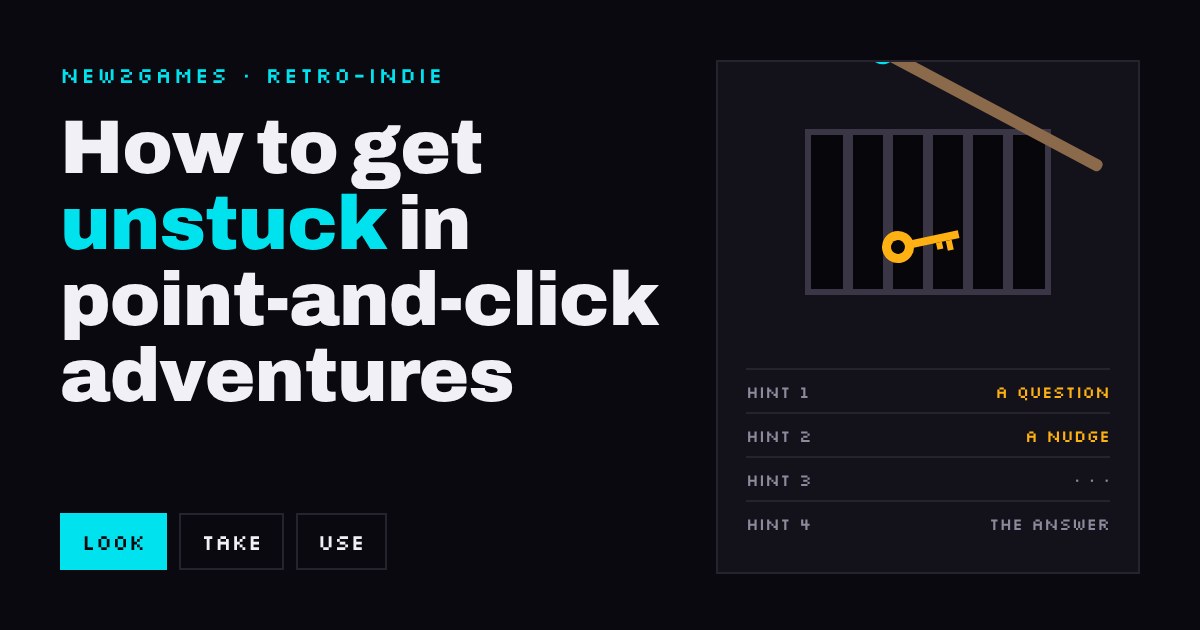
Try it on the tiny puzzle below. Pick a verb, then click a thing. Notice how the list of open problems grows as you look around, and how the first hint for each problem is only a question.
If you solved it without hints, notice what you did: you found the problem (the key in the drain), realised your hand wouldn't do, and combined two harmless things into a tool. That's the whole genre in miniature. If you used a hint, notice that the first rung was usually enough.
Hints are not cheating, but take them in steps
A full walkthrough is the expensive option. It solves the puzzle you're on, and your eye slides down the page and spoils the next three. Graded hints are better: you get a question first, then a stronger nudge, and only at the end the answer. That's how the long-running Universal Hint System works: you reveal hints one at a time, and its page for The Secret of Monkey Island's ravine starts with a small observation and only gives the full solution on the last hint.
Some modern adventures build this in. Return to Monkey Island (2022, PC and Nintendo Switch at launch) gives you a hint book early in the game, from the Voodoo Lady, and you use it from your inventory to get nudges toward your next step. It also offers a Casual mode, where many puzzles take fewer steps than in Hard mode, so the threads you have to keep in your head stay short.
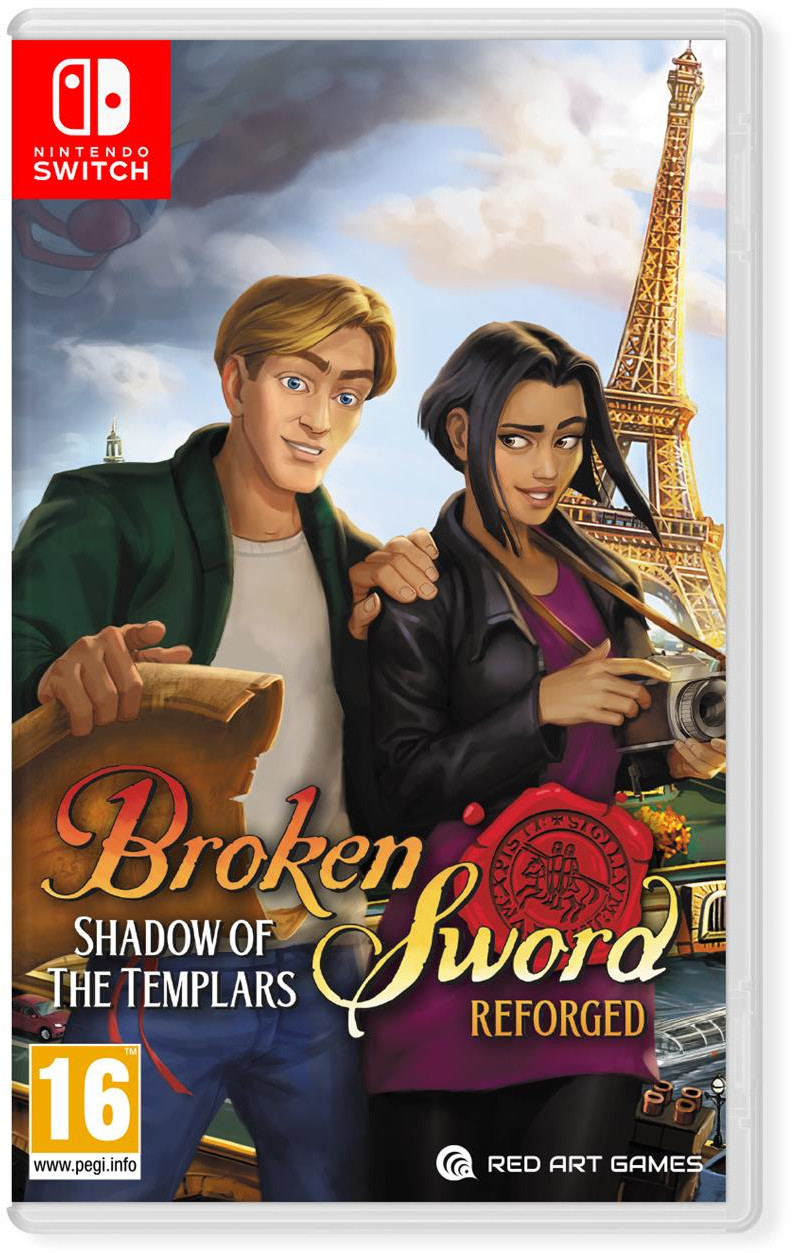
Broken Sword: Shadow of the Templars – Reforged (2024) is a remaster of the 1996 original that adds optional game help: a story recap, hints on demand, and automatic highlighting of things you can interact with. That covers the first two kinds of stuck (not finding things, losing the thread) before you ever need a hint.
Who this approach suits
It's for you if you like stories and puzzles, don't mind slow pacing, and want the satisfaction of solving things yourself without hours of wandering.
It may frustrate you if you want constant action, or if you're playing an older game with no built-in help and hate leaving it to look things up. One warning for older games: some adventures from the early years could let you die or reach a point where the game can no longer be finished. If you're playing a classic and have been stuck for a long time, a quick search for "dead end" plus the game's name tells you whether that's a risk.
The same "isolate the hard part" thinking works in action games too; see beating a hard retro level without save states. And if you're coming to adventures from old survival horror, getting used to tank controls covers the other kind of retro friction.
Quick answers
Is it cheating to use a walkthrough?
No, but a graded hint usually gets you moving while spoiling far less, so try that first.
What is "moon logic" in adventure games?
A puzzle solution that only makes sense after you see it, often because it relies on a joke or a leap the game never set up clearly.
What's a good first point-and-click adventure?
Pick a modern one with built-in help, such as Return to Monkey Island on Casual or Broken Sword Reforged with hints on, so being stuck never lasts long.
Next step: start Return to Monkey Island in Casual mode, keep a notepad next to you, and write down every problem the moment you meet it.