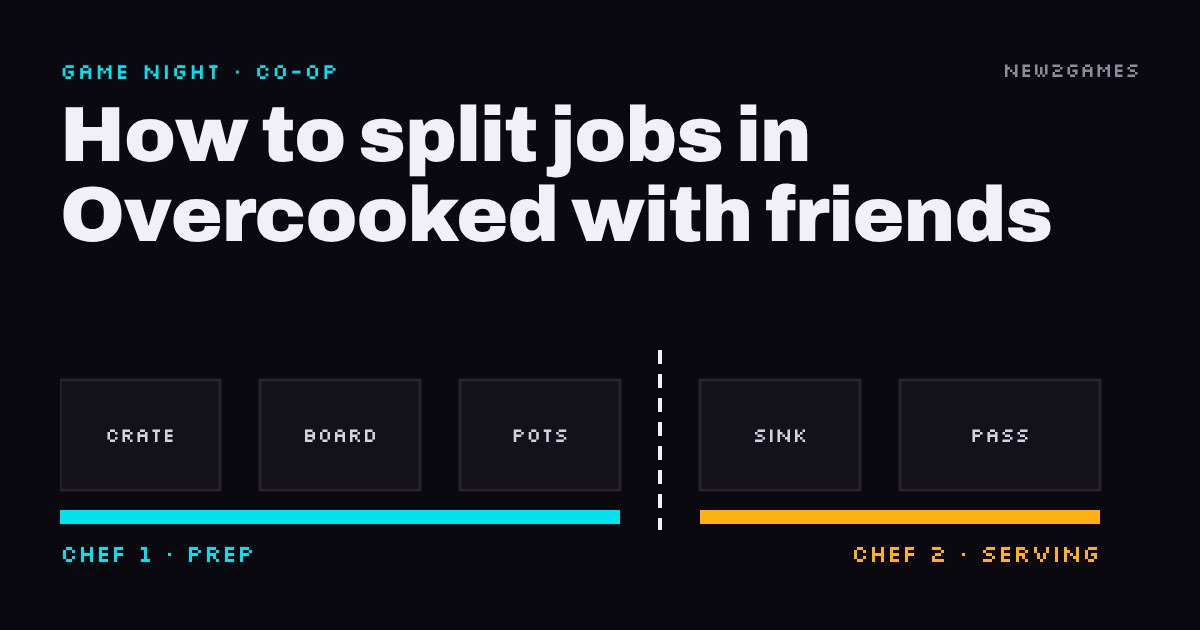
Split the kitchen by station, not by dish: one player preps and fills the pots, the other washes, plates and serves, and you call every handoff.
A plain guide to running a calmer Overcooked night: why kitchens fall apart (walking, queues at the board, bumping into each other), a small simulator that plays out three plans for two or three chefs, how to split the kitchen for two to four players, short callouts that keep both sides in sync, and when the level forces you to break the plan.
▶ Interactive · How to split jobs in Overcooked with friends
Split the kitchen by station, not by dish. In Overcooked with two players, one person preps (fetches, chops and fills the pots) and the other runs the serving end (washes plates, plates up and serves), and you say out loud whenever you hand something over. That one change cuts the walking, ends the queue at the chopping board and stops the two of you colliding in the middle of the kitchen.
If your co-op sessions end with two people shouting "who's on plates?" while a pot burns, nobody is bad at the game. You're both doing every job, so you're both always in the wrong place. Here's how to fix it, with a small kitchen simulator to show why it works.
Why the kitchen falls apart
Overcooked! 2 (Ghost Town Games and Team17, 2018) is a co-op cooking game for up to four players, on one couch or online. Each level is a kitchen against a clock: grab ingredients, chop them, cook them, put them on a plate and serve the orders before they expire. Washing dishes is one of the jobs too.
When everyone does everything, three costs pile up:
Walking. Every trip from the crate to the pass and back is time nobody spends cooking.
Queues. There's usually one chopping board and one sink. Two chefs who both want the board means one of them stands and waits.
Bumping. Two chefs crossing a narrow kitchen in opposite directions slow each other down.
A plan that gives each person a zone attacks all three at once. You stop crossing the room, you stop wanting the same station, and you stop meeting in the doorway.
Try it: three plans, one kitchen
This is a toy kitchen, not the real game: one crate, one board, two pots, one sink and a pass, in a row. Every dish needs fetching, chopping, cooking, a washed plate and serving. Pick a plan and the number of chefs; the chefs play out a two-minute round and the timeline shows what each of them spent their time on.
The two-chef result is the one to remember. Splitting by station gets the most dishes out, mostly because nobody crosses the whole kitchen any more. With three chefs, look at the waiting time: in a kitchen with only two pots, a third person can't make the food cook faster. That's a sign to give them the job that keeps the bottleneck fed, not another copy of everyone else's job.
How to split the kitchen by player count
These are starting points, not rules. Adjust them to the layout in front of you.
Players
A split to start with
2
Prep (crate, board, pots) and serving (sink, plates, pass)
3
Prep, pots, and plates plus serving
4
Two on prep, one on pots, one on plates and serving
Draw the line where the kitchen draws it. If the crate and board sit on one side and the stove and pass on the other, that's your border. Stand on your side, and put finished items on the counter between you instead of carrying them across.
Then swap roles every few levels. The prep job is busy and repetitive; the serving job is calmer but has to watch the clock. Swapping keeps both players learning the whole kitchen, and it means nobody is stuck doing dishes all night.
Say the handoffs out loud
A split only works if each side knows what the other just did. Keep the calls short and about things, not blame: "Chopped on the counter." "Pot's full." "Two plates clean." "Last order, a minute left." One call per handoff is enough. If you're the more experienced player, make most of the calls at first; it's the quickest way to teach the kitchen without stopping the game.
One habit to unlearn: when an order is about to expire, the instinct is to drop your zone and sprint for it. Sometimes that's right. More often it leaves your station empty and the next three orders late. Treat that urge as a warning sign, not a skill. Ask for the item instead.
When to break the plan
Overcooked! 2 likes to move the kitchen under you, with moving floors, portals and fires that block a route. When a level splits you up, the plan becomes whatever the layout allows: whoever can reach the stove handles the stove. Overcooked! 2 also lets you throw raw ingredients to a teammate or straight into a pot, which turns "walk it over" into "throw it over" and makes station play even stronger.
Most of the challenge here is execution (doing things quickly and precisely) under a timer, split between people. There's little consequence to failure: you just replay the level. That makes it a forgiving place to practise teamwork. If the clock is too tight for your group, Overcooked! All You Can Eat, which bundles both games and their extra content, has an assist mode with longer rounds, slower order timers and the option to skip a level.
If you'd rather design the kitchen than survive it, PlateUp! is a roguelite restaurant game for one to four players where you place the appliances yourself and can rearrange the room between shifts. It's the same lesson from the other side: put the stations where your split wants them, and the walking disappears before service starts.
What's the best Overcooked strategy for two players?
One player preps and fills the pots, the other washes, plates and serves, and you call out every handoff.
Should we swap roles?
Yes, every few levels, so both of you learn the whole kitchen and nobody gets stuck on dishes.
Is Overcooked too hard for a beginner?
It's busy rather than punishing: failing just means replaying the level, and All You Can Eat's assist mode slows the clock down.
Next step: at your next game night, pick one early level, agree who's on prep and who's on serving before you press start, and play it twice: once with the split and once without.
Watch it done
4 videos from other creators on this, picked and annotated by us.
Affiliate links, marked sponsored. We may earn a commission at no extra cost to you. Examples that match this guide, not tested reviews. Prices checked 22 Nov; every shop and live prices are on each product page.
The kitchen this guide is built around: Overcooked! and Overcooked! 2 in one, with an assist mode that slows the clock while your group learns to split the stations.