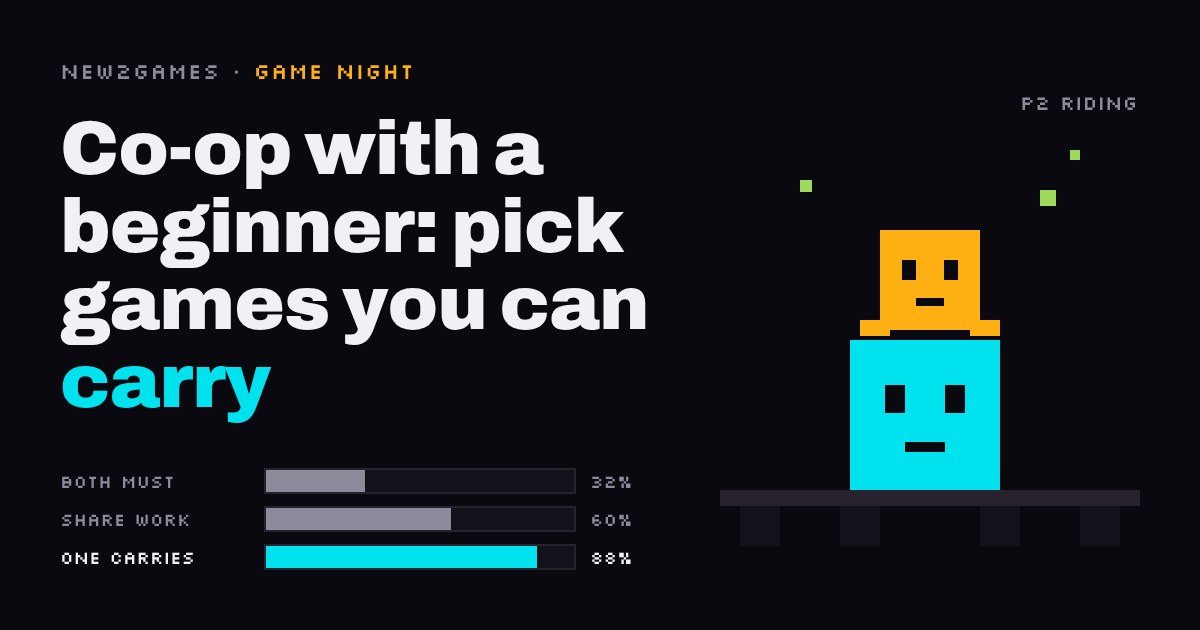
Pick a co-op game where the stronger player can carry the newer one, not one where you both must land every jump, so the team moves at its best player's pace.
This guide explains the three ways co-op games add up two players' skill: both must, share the work and one can carry. A small simulator lets you set each player's chance of clearing a tricky section and see how much the game's structure changes the team's odds. It then sorts Super Mario Bros. Wonder, Kirby's Return to Dream Land Deluxe, Overcooked! All You Can Eat and It Takes Two, and covers how to hand out roles without making anyone feel like a passenger.
▶ Interactive · Co-op with a beginner: pick games you can carry
Pick a co-op game where the stronger player can carry the newer one, not one where you both have to land every jump. In Super Mario Bros. Wonder or Kirby's Return to Dream Land Deluxe, a new player can ride along, get revived or simply not take damage, so the team moves at the pace of its best player. In It Takes Two, each of you has a job only you can do, so the team moves at the pace of whoever is still learning. That one difference decides whether a first co-op night feels like a team effort or like a test.
This guide is about the shape of the game, not about being patient (though that helps). Once you can see how a co-op game adds up two players' skill, you can choose the right one for the person next to you, and set up roles so they enjoy it.
Three ways a co-op game adds you up
Every co-op game quietly answers one question: when one of you fails, what happens to the team? There are three common answers.
Both must. Progress needs each player to do their part. If one of you misses, the team waits or restarts. Your chances multiply: if you clear a tricky section 80% of the time and your partner 40%, you clear it together only 32% of the time. The team is as strong as its weakest link.
Share the work. The team's result is the sum of what you both produce, like a kitchen getting orders out. A newer player who does less still helps, and nobody blocks anybody.
One can carry. If either of you gets through, the team does. Now the same two players clear that section 88% of the time, because the newer player's misses only count when you miss too.
Leave your own slider high and drag your partner's down to 20%. In "Both must" the team now needs about 31 tries to get through five tricky sections; in "One carries" it needs about 6. Then switch the assist on: it helps in every mode, but it rescues "Both must" the most, because that is the mode where your partner's misses cost the whole team.
Where four popular games sit
These labels are our reading of each game's rules, not an official category. For someone new to holding a controller, the difficulty in all four is almost entirely Execution (timing jumps and moving under pressure); Consequence, what a mistake costs you, is low in every one of them.
Game
How it treats a new player
Super Mario Bros. Wonder
One carries
Kirby's Return to Dream Land Deluxe
One carries
Overcooked! All You Can Eat
Share the work
It Takes Two
Both must, gently
Super Mario Bros. Wonder has two characters, Yoshi and Nabbit, who don't take damage from enemies. They can still lose a life by falling off the level, but the most common way to fail is gone. In local play, a defeated player turns into a ghost for a short time, and anyone who touches the ghost brings them back without losing a life. Up to four can play on one Switch, each with a controller.
Kirby's Return to Dream Land Deluxe lets up to four players drop in and out at any time, and players can piggyback: one character stands on another and gets carried. That is the most literal carry in co-op games. The trade-off is real, though: a rider can do nothing except jump off, so it works best as a rest for a hard section, not as a way to play the whole game.
Overcooked! All You Can Eat is a kitchen under a timer, and the kitchen's output is whatever all of you get onto plates. A new player who only washes plates or chops onions is still a real part of the team. Its Assist Mode can slow down order timeouts, lengthen rounds and let you skip a level. The flip side: a busy kitchen is loud, and some people find the clock stressful rather than funny.
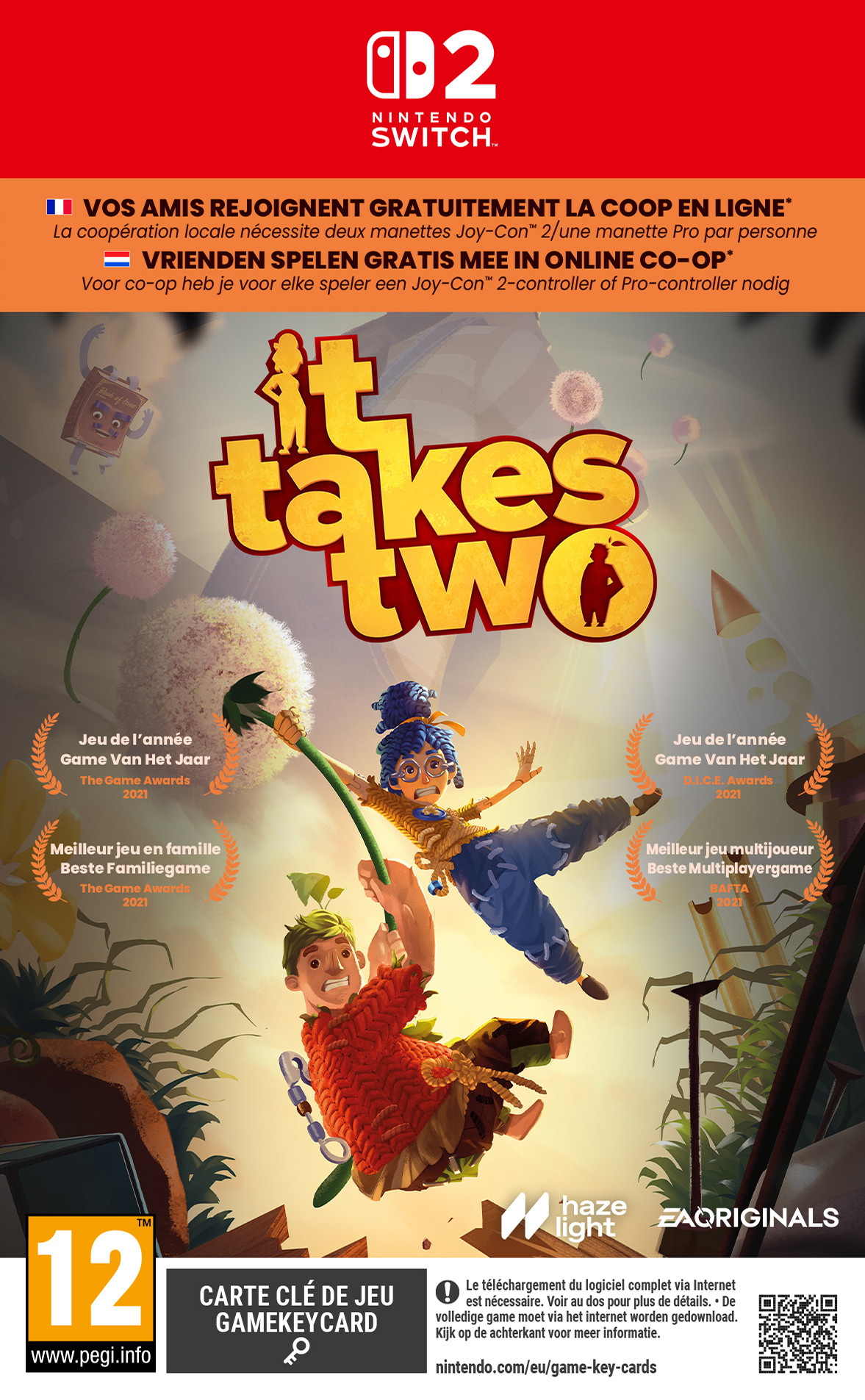
It Takes Two is co-op only and built around splitting jobs: one of you works a contraption while the other crosses it, and neither can finish without the other. That makes it a "both must" game, but a forgiving one: a missed jump puts you straight back, and in fights a downed player can mash a button to come back sooner. Only one of you needs to own it to play online, thanks to its Friend's Pass.
Set the roles before you start
The game's structure does most of the work, but a few habits help:
Offer the carry roles as a choice, not a label. "Yoshi can't get hurt, want to try him?" lands better than "you should be Yoshi". Invincible characters are a fine way to play, not a lesser one.
The stronger player's job is to wait. In most couch co-op games, the screen or camera follows the group. If you race ahead, you drag your partner into situations they didn't choose. Let them set the pace for the first hour.
Turn assists on as a team setting. Assist modes apply to the whole session, so treat them like choosing the difficulty together. Switching them off later is a nice milestone.
The same idea works around a table: if your group plays board games too, our guide to teaching a board game to new players covers how to explain rules without a lecture.
When "both must" is the right pick
The strongest counter-argument to all of this is that being carried can feel like being a passenger. Some new players want equal stakes from the start, and a game where they have a job nobody else can do may hook them more than one where they ride along. That is a fair point, and It Takes Two is a good answer to it once both of you are comfortable moving a character and a camera at the same time. A sensible order is to start with a carry game for a few evenings, then step up to a "both must" game when your partner stops looking at the controller.
Who this is for
This is for anyone who wants to play video games with a partner, friend, parent or kid who rarely plays. If you are both experienced, skip it: "both must" games are often the most satisfying when you are evenly matched.
Quick answers
What is a good first co-op game for a non-gamer?
One where a stronger player can carry the newer one, such as Super Mario Bros. Wonder with the newer player as Yoshi or Nabbit.
Is It Takes Two good for beginners?
It is forgiving about failure, but every puzzle needs both players, so it works best as a second co-op game.
Why does co-op with a new player feel so slow?
In games where both players must succeed, your chances multiply, so the team moves at the pace of whoever is still learning.
Next step: pick up Super Mario Bros. Wonder, hand your partner Yoshi, and play the first world together.
Loadout · gear used
Affiliate links, marked sponsored. We may earn a commission at no extra cost to you. Examples that match this guide, not tested reviews. Prices checked 29 Oct; every shop and live prices are on each product page.
The first pick for a new player: Yoshi and Nabbit don't take damage from enemies, and a defeated player comes back as a ghost a teammate can touch to revive.