
Wingspan Snelstarter Set - Bordspel
The guided first-game pack the guide mentions: pre-set hands and guide sheets so new players learn by playing.
- Dutch edition
- Guided first game
€5
999Games ↗
specs, live price ▸
Teach the goal first, then how the game ends, then what you do on a turn, and start playing; explain the rest when it comes up.
A full rules dump asks new players to hold dozens of rules before they have touched a piece. This game night guide shows a short, goal-first teach using Ticket to Ride, how to save edge cases for the moment they happen, and why an open-handed first round beats any explanation. Build your own teach in the interactive and watch the talk time and the "likely to stick" meter move.
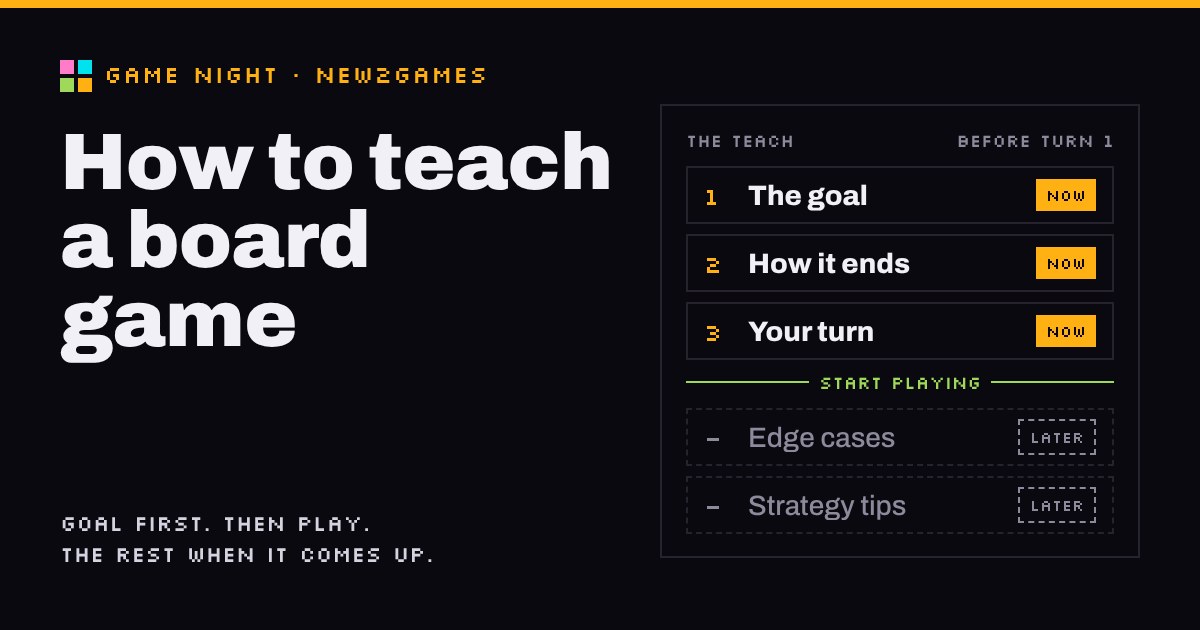
To teach a board game so new players enjoy their first game, tell them the goal first, then how the game ends, then what they can do on a turn, and then stop talking and start playing. Everything else (scoring details, exceptions, strategy) gets explained the moment it first matters. Play the first round with hands open so you can coach, and the table will be having fun while a rules-dump teach would still be going.
You know the game, so every rule you say clicks into a picture you already have. Your new players have no picture yet. To them, a rule about trading resources or claiming routes is a rule about nothing, and it slides off.
There is a real limit behind that feeling. Memory researcher Nelson Cowan's work suggests adults can actively hold only about 3 to 5 meaningful items in mind at once. Nobody has measured board game teaches against that number, but the lesson is plain: fifteen separate rules are far more than anyone can hold, while "you're racing to connect cities, and on your turn you do one of three things" is a frame that later rules can hang on.
On this site we describe difficulty by its sources instead of one number. For someone learning a board game, the loud source is Systems: knowing how the rules fit together. A long upfront teach makes a new player carry all of that before they have moved a single piece. A short teach spreads the Systems load across the game, where each rule arrives with a real example on the table.
We'll use Ticket to Ride as the running example, because plenty of hosts own it and its turn is simple. Here is the whole teach before turn one:
That's it. Deal the starting tickets (each player keeps at least two of three) and start. The goal gives every later rule a reason. The ending spares anyone a surprise at the finish. The turn is the one thing a player needs in order to act.
Try it yourself below: reorder the chunks of a teach, choose what you explain up front and what you save for later, and watch the estimates move.
Load the rules dump and the talk before the first turn balloons while the "likely to stick" bar collapses. Then switch the details to Later and put the goal back on top. The two big wins come from moving things, not cutting them: nothing in a good teach is skipped, it's just said at a better moment.
Call it "just in time" teaching: a rule is taught the first time it can actually happen, not the first time you can imagine it. In Ticket to Ride, two small rules trip up new players. If you take a face-up locomotive (the wild card), that's your only card that turn. And with only two or three players, just one of each pair of double routes can be used. Neither needs saying before turn one. Say it when someone reaches for a locomotive or eyes a double route, and it will stick, because the player is holding the exact situation in their hands.
Scoring works the same way. Give the headline up front ("routes and tickets score, unfinished tickets cost you") and save the details, such as the 10-point bonus for the longest continuous route, until someone could plausibly chase it, or until the count at the end.
The best teaching tool you have is the first round itself. Agree before you start that the first round, or the whole first game, is a learning game. Play it with hands face up. Think out loud on your own turns ("I'm drawing cards because I need three more reds for this route") and let people ask "what would you do here?" without it feeling like cheating.
Some publishers now build this in. Current printings of Wingspan include the Swift-Start pack, with guide sheets that walk new players through their first four turns. If your game has a learning scenario or a beginner setup in the rulebook, use it.
A few small habits help as much as the order does:
Some players hate surprise rules. If a rule they didn't know about costs them the game, a short teach can feel like a trap, and experienced players in particular may want every rule up front. That's fair. The fix is to name what you're holding back in one line ("there are rules for wild cards, double routes and an end bonus; I'll explain each before it can bite you") and keep that promise. And if your group genuinely enjoys the full read-through, give them that.
As short as it can be while still letting people take their first turn: for a light family game that's often just a few minutes, with everything else explained during play.
Usually not; most rulebooks are written as complete references, not as a script for teaching, so read it yourself beforehand and teach in your own words, goal first.
Give them the headings of the rules you're saving for later and promise to explain each one before it can affect them.
Your next step: before your next game night, write your teach for one game on a single index card: the goal, how it ends, and what you do on a turn. If it doesn't fit on the card, it's too long for before turn one.
The guided first-game pack the guide mentions: pre-set hands and guide sheets so new players learn by playing.
The base game. Teach it goal first, then the turn, and save the bonus cards for when they come up.
